









Digital marketing isn't going anywhere. Businesses of every size need help showing up online. They need someone to run their ads, manage their social media, fix their SEO and write content people actually read. That someone could be you. The numbers back this up. The global digital advertising market crossed $600 billion in 2023.
Agencies that focus on just one or two services are growing faster than generalist shops, and freelancers who niche down often charge up to three times more. The demand is real and continuing to grow. If you're looking to build a business around digital marketing solutions for business growth, you don’t need a fancy office or a large team. What you need is a clear plan, a few core skills, and the patience to build something that lasts. This guide gives you all three.
Most traditional businesses are held back by startup costs that slow you down. A restaurant needs a lease. A product business needs inventory. A digital marketing agency needs your time, a laptop and a few tools.
The barriers to entry are low. But the skill ceiling is high. That's what makes it a great business. Anyone can call themselves a marketer. Very few can actually deliver results. If you can close that gap, you'll always have clients.
You don't need to be an expert in everything before you start. You need to be solid in at least one or two areas and honest about the rest.
Core skills that matter:
SEO: Understanding how search engines rank content and how to improve it.
Paid Ads: Running Google or Meta campaigns with a clear return on spend.
Content Marketing: Writing or managing content that builds trust and drives traffic.
Social Media Marketing: Growing audiences and turning followers into buyers.
Email Marketing: Building lists, writing sequences and nurturing leads.
Analytics: Reading data and making decisions based on what it says.
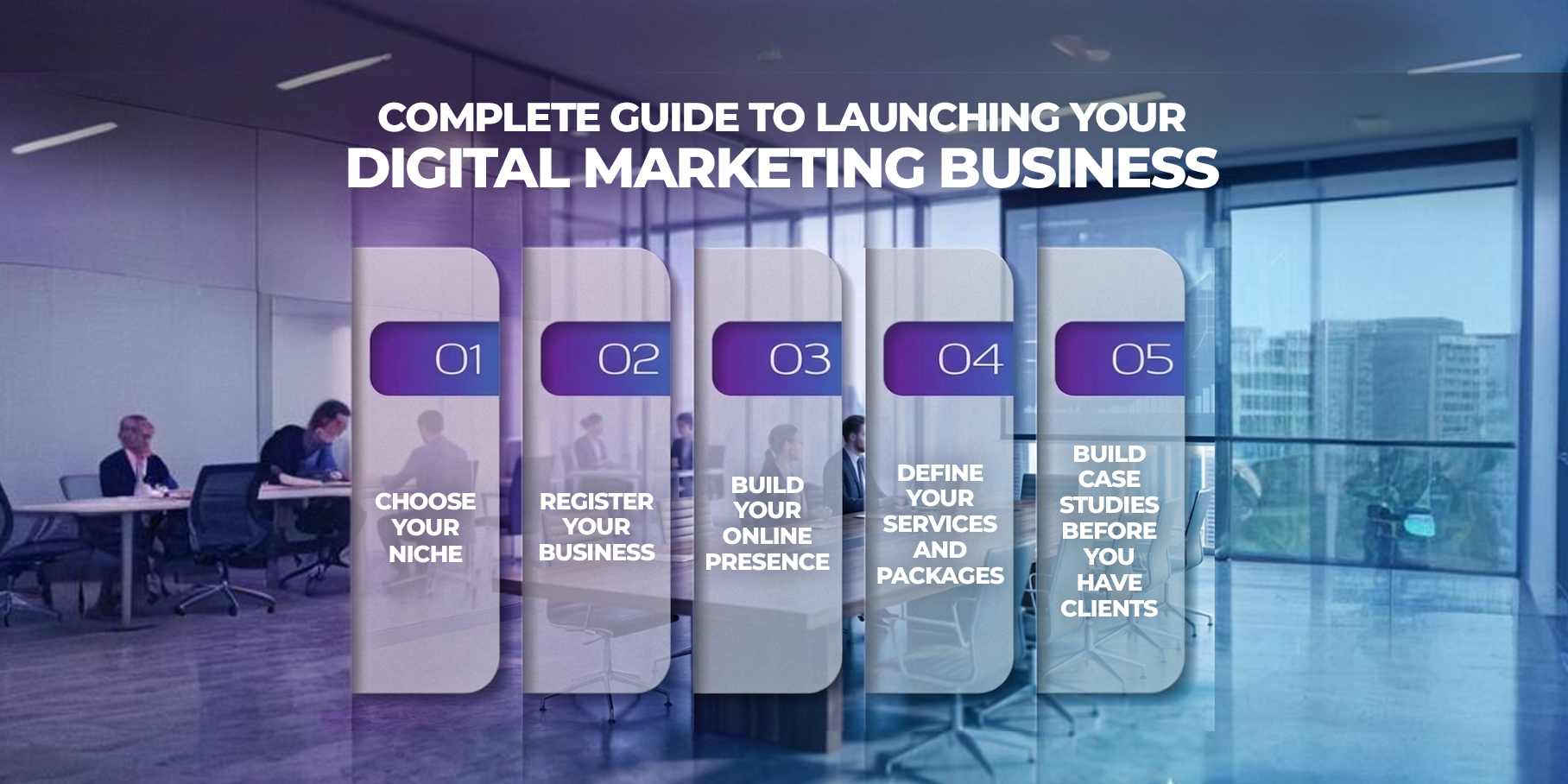
The biggest mistake new agencies make is trying to serve everyone. Don't. Pick an industry you understand. Restaurants, e-commerce stores, law firms, and real estate agents all have different problems and different budgets.
Niche + service = positioning. I do SEO for SaaS companies, which is far more compelling than I do digital marketing. Specificity builds trust.
This doesn't need to be complicated. Set up a sole proprietorship or LLC, depending on your location. Open a business bank account. Get a simple contract template. These basics protect you and make you look professional from day one.
You're a digital marketer. Your own online presence is your first portfolio piece. Build a clean website that explains what you do, who you help, and what results you've gotten. If you're just starting, document your process and show your thinking.
Your website should also be built with SEO in mind. Practice what you preach. If you're promising clients organic growth, make sure your own site shows up when people search for your services.
Don't offer 12 services. Pick two or three that you can deliver well. Bundle them into packages with clear pricing. Monthly retainers work better than one-off projects because they give you a predictable income.
No one wants to be your first client. So get there faster. Offer one or two free or discounted projects to local businesses or friends. Track the results. Write them up. Now you have a case study. Real results beat a polished pitch deck every time.
Not all services are equal in terms of how easy they are to deliver or how much clients will pay. Here's a quick breakdown:
SEO is a long-game service. Clients need to commit to 6 to 12 months before they see real results. It pays well and compounds over time, but requires patience on both sides.
Paid ads (PPC) deliver faster results. Clients see ROI within weeks if you set things up right. This makes it easier to justify the cost. But it requires constant attention and testing.
Content marketing and social media management are great for retainers. They're ongoing by nature and easier to scope. The downside is that results may emerge more slowly and be harder to attribute.
Email marketing is underrated. Open rates are high, cost per conversion is low and most businesses have an audience they're not using. If you can write well and understand automation, this is a strong service to lead with.
You don't need to spend thousands on tools when you're starting. Keep it lean.
Google Analytics and Google Search Console are free and essential.
Semrush or Ahrefs are for SEO research and competitive analysis.
Meta Ads Manager and Google Ads are used to run paid campaigns.
Canva is for quick visuals and social content.
Notion or ClickUp are for project management and client reporting.
Mailchimp or ActiveCampaign are for email marketing execution.
Slack or Loom are for client communication without endless emails.
This is where most people get stuck. They build a website, set up socials and then wait. Don’t wait. Your first clients will almost always come from your existing network. Studies from Nielsen show that 92% of people trust recommendations from people they know, making personal connections one of the most effective ways to land early clients. Tell people what you’re doing, post about it, and reach out directly to businesses you already have relationships with.
Cold outreach works too, if done right. Focus on businesses with clear, visible problems you can solve. Research shows that personalized outreach significantly increases response rates compared to generic pitches. Whether it’s an incomplete Google profile, inactive social media, or poor search visibility, lead with the problem, not the pitch.
LinkedIn is often underused by new agency owners, yet it remains one of the most effective platforms for B2B lead generation. According to HubSpot, LinkedIn generates over 80% of B2B leads from social media. Posting consistently, engaging with decision-makers, and reaching out with specific insights can build strong opportunities. Over time, referrals become your most valuable channel, especially since research shows referred customers convert faster and have higher lifetime value. Always ask satisfied clients who else they can connect you with.

Pricing is where confidence matters as much as strategy. New agency owners often underprice out of fear, but low rates usually attract the wrong clients, those who undervalue your work and create more friction. Setting clear, value-based pricing helps position your services professionally and attract better clients.
A simple pricing structure can vary by service. SEO retainers typically range from $800 to $2500 per month. Paid ads management is often priced at 15–20% of ad spend with a minimum fee. Social media management usually falls between $600 and $1500 per month, while content writing can range from $150 to $500 per piece. Email marketing services are commonly priced between $500 and $ 1,500 per month. Pricing should reflect the value delivered, not just the time spent, especially when campaigns directly contribute to measurable business growth.
Reaching your first few clients proves demand, scaling beyond that requires systems. Document your processes early, from onboarding to reporting, so you can delegate and maintain consistency as you grow. Focus on a niche. The more you work within one industry, the stronger your expertise and results become.
This specialization gives you a clear competitive edge. At the same time, continue investing in your own marketing, consistent outreach, valuable content and strong case studies to maintain a reliable, growing pipeline of clients. Track key metrics like recurring revenue, client retention, and sales cycles. Growth comes from clarity. And as you scale, be selective, taking on the right clients matters more than taking on more clients.
Starting a digital marketing business doesn’t require a massive investment or years of experience. It requires clarity on who you help, honesty about what you can deliver, and the consistency to keep showing up even when growth feels slow. The market is big enough. The demand is real. The question is whether you're willing to put in the work to build something worth having.
Start small. Get results. Let the results do the talking. And if you want to understand what scalable growth looks like in practice, explore how a software development and digital solutions company builds the systems that support long-term success.
Honestly, not much. You can start with under $500. A domain, basic hosting, a few tool subscriptions and a contract template. The real investment is time. Most of the heavy lifting in a new agency is skill and hustle, not capital.
No degree required. Clients care about results, not credentials. That said, certifications from Google, Meta and HubSpot add credibility and teach you real-world skills. They're free or low-cost and worth doing early on.
If you're actively reaching out, it can happen within two to four weeks. Most people take longer because they're waiting for clients to find them instead of going to find clients. Direct outreach through your network and LinkedIn is the fastest path to that first paid engagement.
Specialize first. You'll close more clients, charge more and deliver better results when you focus. Once you have steady revenue and a team, you can expand. Trying to do everything at the start leads to doing nothing particularly well. Niche down and win there first.