








You’ve got a software idea or a product that needs serious execution and now you’re at a critical decision point: build an in-house team or outsource development. It may seem straightforward, but this choice can shape your timeline, budget, and overall product success.
Make the wrong call, and you risk delays, rising costs, and missed opportunities while competitors move ahead faster. The right approach isn’t about what sounds better; it’s about what fits your stage, resources and long-term goals. This guide breaks down the real differences between in-house and outsourced development so you can make a smarter, more confident decision and understand where software development services fit into your strategy.
An in-house development team is made up of full-time employees who work directly for your company. They sit inside your organization, either physically or as remote employees on your payroll. You recruit them, train them, manage them, and pay their salaries and benefits. They live and breathe your product every day.
Your product is your core business (e.g., a SaaS platform you sell)
You have long-term, ongoing development needs
You need deep institutional knowledge and tight company culture alignment
Data privacy or IP sensitivity makes third-party access risky
Recruiting takes time; great developers are in high demand
High fixed costs: salaries, benefits, equipment and office space
Hard to scale quickly when project demands spike
Skill gaps are expensive to fill when you need a specialist fast.
Outsourced software development means you hire an external team, agency, or freelancers to build or support your product. They work independently outside your company's internal structure.
You define the scope, set the expectations, and the external team delivers. You are buying a result, not managing full-time employees.
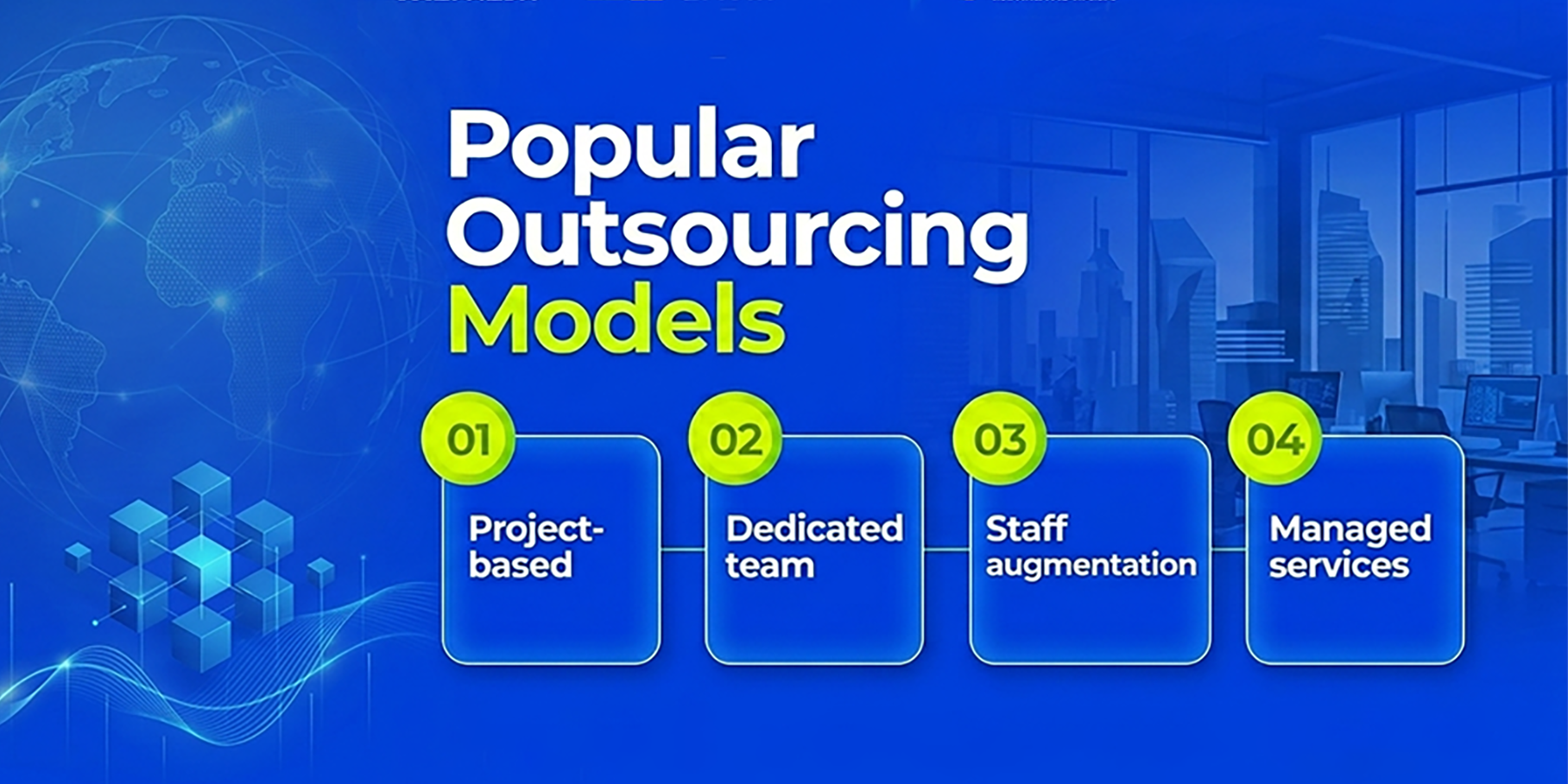
Project-based: A defined scope with a fixed price and timeline
Dedicated team: An external team assigned exclusively to your product
Staff augmentation: External developers added to fill gaps in your in-house team
Managed services: Full ownership of delivery handed to the vendor
According to Gartner research, global IT outsourcing continues to grow as companies prioritize speed-to-market and specialized skills over traditional hiring. The core appeal is simple: you get experienced developers working on your product, often in days rather than months.
No long recruitment cycles
Access to specialized skills instantly
Lower overhead compared to a full in-house headcount
Flexibility to scale teams up or down based on workload
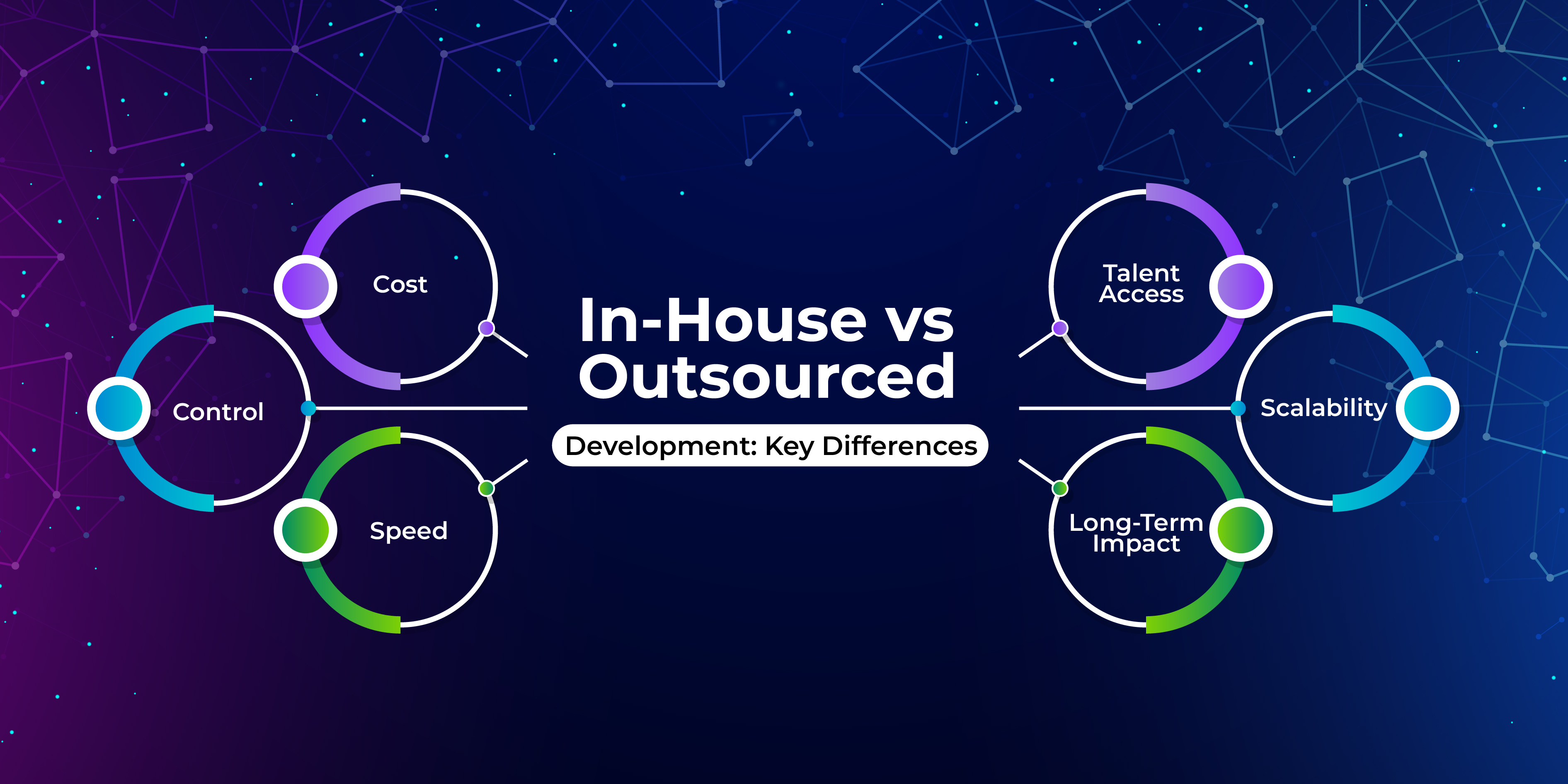
Here is the honest comparison across the metrics that matter most when you are making this decision.
In-house development carries high fixed costs. Salaries, benefits, tooling, onboarding, and turnover all add up fast, even before a single line of code ships. Outsourcing converts those fixed costs into variable ones. You pay for what you need, when you need it.
In-house gives you full visibility and real-time direction. But outsourcing, done right with clear processes and communication rhythms, can deliver the same level of control without the overhead.
Hiring a great engineer in-house can take three to six months. An established outsourcing partner can onboard a team and start sprinting within two weeks.
Your local hiring pool is limited. Outsourcing opens your product to world-class engineers from Eastern Europe, South Asia, Latin America, and beyond, often at competitive rates.
Need five more developers for a three-month push? Outsourcing makes that easy. Scaling an in-house team that fast is nearly impossible without high cost and disruption.
In-house teams build institutional knowledge. Outsourced teams can be a starting point or a permanent, cost-effective solution depending on how you structure the engagement.
Factor | In-House Team | Outsourced Development |
Monthly Cost | High (salaries, benefits, tools) | Flexible, pay per project/hour |
Setup Time | Weeks to months | Days to a few weeks |
Talent Pool | Limited to the local market | Global talent access |
Control Level | Full direct control | High with clear processes |
Scalability | Slow, expensive to scale | Scale up or down instantly |
Communication | Real-time, in-office | Requires structured async flow |
IP Ownership | Clear ownership | Defined in contract |
Long-Term Fit | Best for core product teams | Best for projects & sprints |
Risk Level | Lower team risk, higher fixed cost | Lower cost risk, needs vetting |
Deep alignment with company culture and long-term product vision
Real-time collaboration and instant feedback loops
Strong sense of ownership and team accountability
No knowledge transfer needed between engagements
Better for highly sensitive or regulated industries
The pros are clear: speed, cost efficiency, global talent and scalability. But outsourcing has real risks too.
Communication gaps if time zones and handoff processes are poorly managed
Quality varies widely depending on the vendor you choose
Less institutional knowledge accumulates over time
Dependency on the vendor relationship for continuity
The good news? Each of these risks is manageable with the right partner and contract structure.
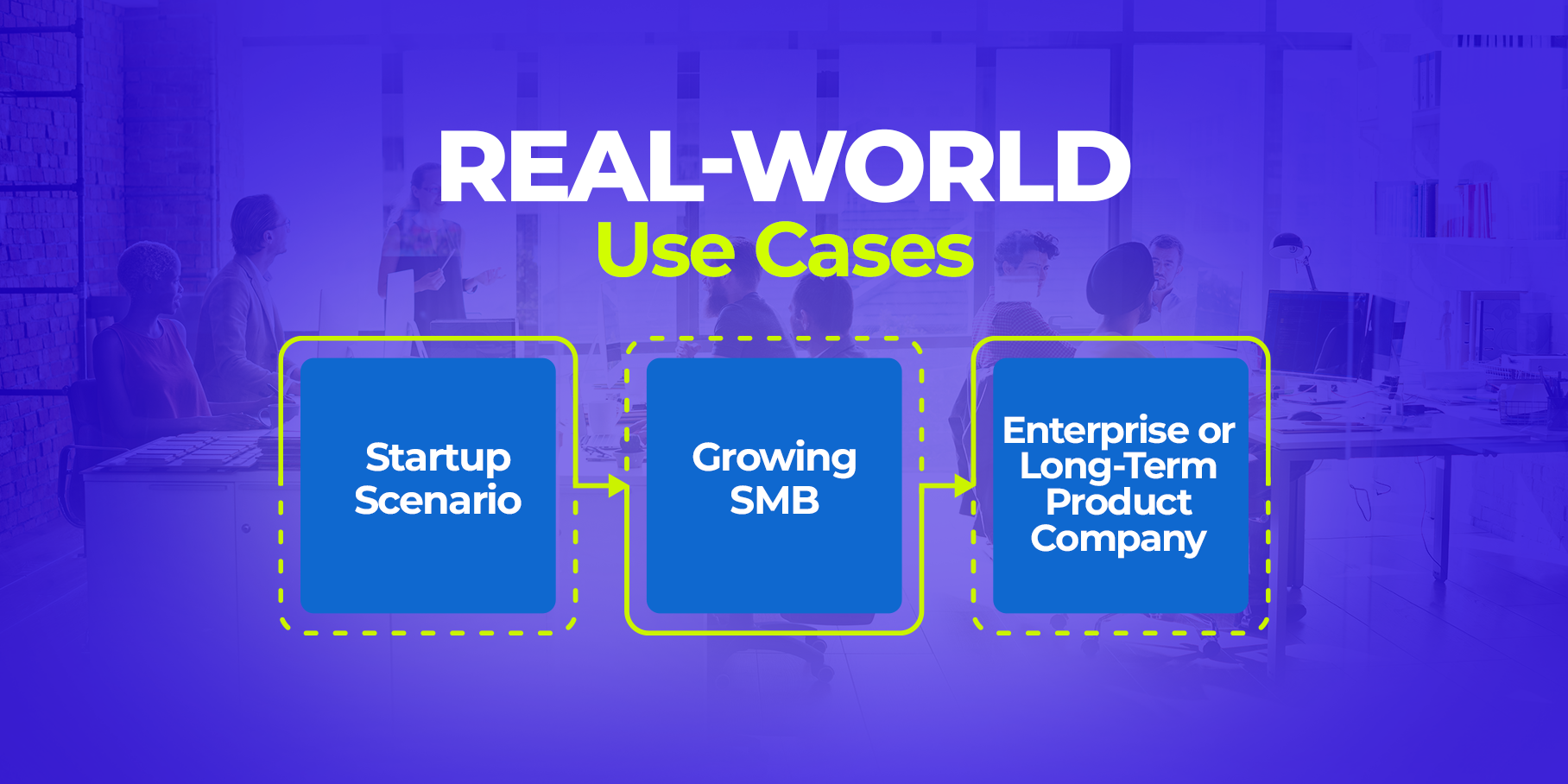
You are pre-Series A with $400K in funding. You need to ship a product in 90 days. Hiring an in-house team is not realistic; it would cost you six months and most of your runway before a single feature ships. Outsourcing gets you a full-stack team in two weeks, lets you validate your product, and gives you leverage to raise your next round with real traction.
You have a small in-house team, but the roadmap is piling up. You need to move faster without burning out your current developers or hiring five people for a single sprint. Staff augmentation, adding two or three outsourced engineers to your existing team, gives you the capacity you need without permanent headcount.
Your core product is mature, and your team is stable. But you need a new AI module built by the end of the quarter. Outsourcing that specific component to a specialized team keeps your core team focused, reduces distraction and brings in niche expertise you do not need long-term.
Use this practical checklist to evaluate your needs, constraints, and long-term goals before committing to a development model. Honest answers now prevent costly mistakes later.
Your software is the core of your business model.
You have a 12+ month stable development roadmap.
You can afford $100K+ per engineer per year, fully loaded.
You have the time to recruit, onboard, and manage a team.
Data sensitivity or compliance makes outsourcing legally complex.
You need to ship fast and your timeline is 30 to 90 days.
Your budget is tight and fixed overhead is a risk.
You need specialized skills that you cannot easily hire locally.
Your development needs are project-based or cyclical.
You want to test a market before making a permanent team investment.
Here is what the most successful companies actually do: they combine both.
A core in-house team owns the product vision, architecture decisions, and long-term roadmap. Outsourced teams handle specific projects, surge capacity, and specialized builds without adding permanent overhead.
You do not have to choose one model forever. The smartest teams evolve their structure as the company grows.A seed-stage startup might outsource everything. By Series B, they have a hybrid model, a small core team augmented by trusted external partners. That is not a fallback. It is a strategy.
There’s no universal winner in the in-house vs outsourced development debate, it all comes down to your stage, budget, timeline and risk tolerance. What matters most is making a deliberate, informed decision based on real constraints, not assumptions.
Both models have clear advantages, and for many businesses, a hybrid approach offers the best balance of speed, cost, and control. Choose the path that aligns with your goals and positions you to move forward with confidence.
In most cases, yes. Startups benefit from outsourcing because it dramatically reduces time-to-market and fixed costs. You get experienced engineers building your product immediately, while your leadership stays focused on growth, fundraising, and customers not hiring pipelines.
The top risks are poor communication, inconsistent quality, and weak IP protection. You mitigate them by choosing a vendor with a strong portfolio and references, establishing clear contracts with defined deliverables, setting up regular sprint reviews, and using time-tracked reporting. A good partner makes transparency easy, not optional.
Absolutely, and in many cases, they exceed it. Senior outsourced developers often have broader exposure across industries and tech stacks than an equivalent in-house hire. The key is vetting the team's experience upfront and setting clear quality benchmarks in the engagement structure.
A hybrid model is almost always the answer for scaling companies. Keep a small, high-ownership in-house team at the core focused on architecture and product strategy. Use outsourced teams to accelerate feature development, handle specialized builds, or manage burst capacity. This approach controls costs while maintaining quality and speed.