








Your audience does not start with the same level of knowledge. Some people do not know they have a problem. Others know the problem but have no idea how to solve it. Some already know your product and only need a reason to act.
That difference matters.
The 5 stages of awareness give marketers a simple way to understand where a prospect stands and create more effective digital marketing messages. Once you know the stage, you can shape your message around it.
The goal is to meet the customer with the right message at the right point.
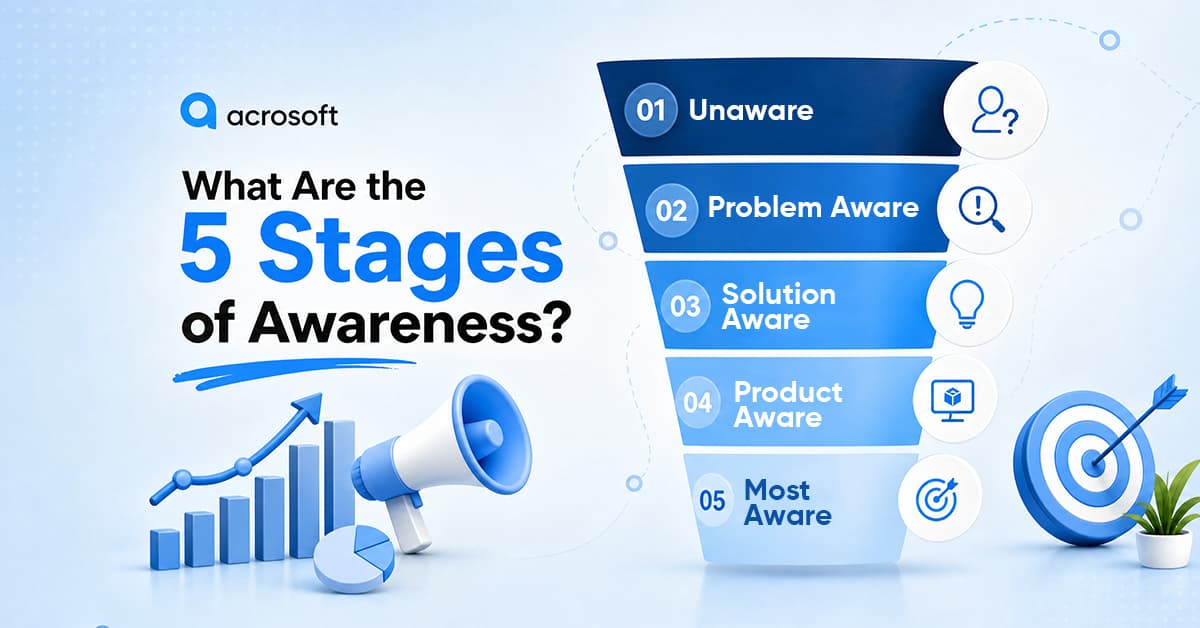
The 5 stages of awareness describe how much a prospect knows about their problem, possible solutions, and your product.
Copywriter Eugene Schwartz introduced the framework in Breakthrough Advertising. He outlined five levels:
Unaware
Problem Aware
Solution Aware
Product Aware
Most Aware
Each stage calls for a different type of copy. An unaware prospect needs a reason to pay attention. A product-aware prospect needs stronger proof or a clear reason to buy. So, effective copy starts with awareness. It does not start with the product.
A strong message can still fail if it reaches the wrong audience at the wrong stage.
For example, imagine someone who has never heard of your software. A detailed product comparison may mean little to them. They first need to understand the problem your software addresses.
Now consider a prospect who already knows your product. They do not need a basic explanation. They may want pricing, proof, features, or a reason to choose you. The 5 stages of awareness help you make that distinction.
They also make content planning easier. You can create different messages for different levels of customer knowledge instead of using one message for everyone.
The five stages show how customer knowledge changes. Each stage represents a different level of awareness, so your message should change based on what the audience already knows.
An unaware prospect does not recognize the problem you want to address. They may experience symptoms without understanding their cause. They are also unlikely to search for your product or category.
Your copy should start with something familiar. Use a situation, frustration, desire, or pattern that catches their attention. Avoid leading with product features because the prospect has no reason to care about them yet. Instead, connect with an experience they already recognize.
Audience Example: Small business owners who spend hours answering customer questions but have not yet realized that repetitive manual tasks are slowing down their teams.
Goal: Get their attention and help them recognize the problem.
A problem-aware prospect knows something is wrong. They may feel frustrated with slow sales, poor website performance, high churn, or another business problem. However, they may not know which solution fits their needs.
At this stage, your copy should show that you understand the problem. Explain what causes it and discuss its impact. Then introduce possible ways to address it without pushing too hard for a sale.
Audience Example: Business owners who know their website is generating traffic but not enough leads and want to understand what may be causing the problem.
Goal: Help them understand the problem and see that a solution is possible.
A solution-aware prospect knows that solutions exist. They may have discovered a category, method, or approach that addresses their problem. However, they may not know which product or company to choose.
Show how your approach works. Explain its advantages and address common concerns. Your copy should make the solution feel practical and relevant to the prospect's situation.
Audience Example: Business owners who know SEO can improve organic traffic and are exploring different SEO agencies, tools, or strategies.
Goal: Show why your approach is worth considering.
A product-aware prospect knows about your product. They may have visited your website, read your content, compared alternatives, or interacted with your brand. Still, they have not made a purchase.
At this stage, the prospect needs a stronger reason to act. Use proof, product details, testimonials, case studies, pricing information, or comparisons when relevant. These elements can reduce doubt and help the prospect evaluate your offer.
Audience Example: Prospects who know your product, have compared it with alternatives, and are considering whether it is the right choice.
Goal: Build confidence and give them a reason to choose your product.
A most-aware prospect already knows your product and understands its value. They may have bought from you before or may be ready to make a decision. This audience does not need a long introduction.
Focus on the next action. Highlight the offer, price, availability, bonus, renewal, or other relevant buying detail. Keep the message clear and make the path to action easy.
Audience Example: People who know your product, understand its value, and may be ready to buy or buy again.
Goal: Make the next action easy and give them a clear reason to act now.
Knowing the stage is only the first step. Your copy must also match that stage.
Educational content such as blog posts, articles, social media posts, and videos can introduce common concerns or situations potential customers may recognize. Use these formats to start with the prospect's world rather than your product. Talk about familiar frustrations, goals, habits, or situations that can help them recognize an issue they may not have considered before.
For example, a SaaS company targeting unaware prospects could publish a blog post about why teams lose time on repetitive tasks. The content should create curiosity and help the reader think, “That sounds like my problem,” without immediately promoting the product.
Educational guides, problem-focused blog posts, checklists, and webinars can help prospects understand what is causing the problem and what impact it may have. Use these formats to name the problem clearly, explain its causes, and show the cost of leaving it unresolved. You can then introduce the idea that a solution exists without pushing for an immediate sale.
For instance, a marketing agency could create a guide explaining why a website gets traffic but fails to generate leads. The reader already sees the problem, so the content should provide clarity and help them understand what may be causing it.
Comparison guides, solution-focused articles, case studies, webinars, and product education can help prospects evaluate different approaches. Use these formats to explain how different solutions work, address common concerns, and show which approach may fit the prospect's needs.
For example, a project management company could compare different ways teams can organize tasks and deadlines. The prospect already knows a solution is needed, so useful details can help them narrow their options.
Case studies, testimonials, product demos, comparison pages, reviews, and product guides can help prospects evaluate your offer. Use these formats to provide proof, address objections, and show specific reasons to choose your product.
For example, a SaaS company could use a case study to show how its software helped a customer improve project visibility. The prospect already knows the product, so proof and specific value can help reduce uncertainty and build confidence.
Offers, pricing pages, product updates, promotions, renewal emails, and direct sales messages can help most-aware prospects take action. Use these formats to highlight the offer, remove unnecessary friction, and make the next step clear.
For example, a SaaS company could send an existing customer a renewal email with a clear price, renewal date, and direct CTA. The customer already understands the product, so they need relevant buying details rather than more education.
A single SaaS product can speak to every awareness stage. The message changes based on what the prospect already knows and what you want them to do next.
Imagine a project management platform. An unaware message might focus on a common situation: “Your team spends more time checking updates than doing the work.”
The message starts with a familiar frustration rather than a product feature. This helps the prospect recognize an experience they already have without asking them to think about a solution yet.
Psychological Impact: Recognition can create curiosity because the prospect sees their own experience reflected in the message.
Short-Term Effect: The prospect may stop, pay attention, and become curious about why the problem is happening.
Long-Term Effect: Continued exposure to relevant content can help the prospect recognize the problem and become more receptive to potential solutions.
A problem-aware message could say: “Scattered project updates make it harder to track deadlines and keep everyone aligned.”
The message names the problem directly because the prospect already knows something is wrong. It helps them understand the issue before introducing a specific solution.
Psychological Impact: Naming the problem can give the prospect greater clarity and make them feel that the message understands their situation.
Short-Term Effect: The prospect may engage with educational content or start looking for ways to solve the problem.
Long-Term Effect: Continued education can help move the prospect toward solution awareness while building trust in the brand.
A solution-aware message could introduce project management software: “Give your team one place to manage tasks, deadlines, and project updates.”
The prospect already understands the problem and knows that solutions exist. The message now presents a possible approach without asking them to choose a specific product immediately.
Psychological Impact: Presenting a clear solution can give the prospect a sense of direction and help them evaluate different approaches.
Short-Term Effect: The prospect may research project management tools, compare approaches, or look for more information.
Long-Term Effect: Useful solution-focused content can position the brand as a credible option when the prospect is ready to evaluate specific products.
A product-aware message could focus on the specific product: “Manage projects, assign tasks, and track deadlines from one workspace.”
The prospect already knows the product, so the message focuses on its specific value rather than explaining the general problem or solution category.
Psychological Impact: Specific product information and proof can reduce uncertainty and strengthen the prospect's confidence in the buying decision.
Short-Term Effect: The prospect may compare features, review testimonials, visit the pricing page, or start a trial.
Long-Term Effect: Strong product experiences and consistent proof can increase trust and support conversion or repeat purchases.
A most-aware message could focus on action: “Start your free trial today and organize your next project in minutes.”
The prospect already understands the product and its value. Instead of providing more education, the message focuses on removing friction and making the next step clear.
Psychological Impact: A clear offer can reduce decision friction and give the prospect a specific reason to act.
Short-Term Effect: The prospect may start a trial, make a purchase, or take another desired action.
Long-Term Effect: A positive buying experience can encourage repeat purchases, renewals, and stronger customer loyalty.
You do not need to guess. Customer questions, search behavior, and actions can reveal how much people know.

Start by studying what customers ask.
Look at sales calls, support tickets, reviews, surveys, and customer interviews.
Ask:
What Problem Does the Customer Describe?
How Well Do They Understand the Cause?
Which Solutions Do They Mention?
Are They Comparing Different Products?
Have They Asked About Pricing or Features?
These answers reveal the customer's current level of knowledge.
Search intent gives you another useful signal.
Let’s analyze a few examples:
A query like “why are SaaS leads dropping” often points to a problem-aware audience.
Someone searching for “best CRM for SaaS startups” shows stronger solution awareness.
A pricing query such as “HubSpot pricing” indicates product awareness.
This shows that search terms can guide both content topics and copy angles.
Customer actions also tell a story. Someone reading an introductory blog post has different needs from someone visiting your pricing page.
Look at page visits, product demos, email clicks, trial activity, and repeat visits. For example, repeated visits to a pricing page often show stronger buying intent.
Use these signals to adjust the message.
The framework works across multiple marketing channels.
Your homepage often serves different audiences at once. Make the main message easy to understand. Then give visitors clear paths to learn more, compare options, or take action.
Product and service pages can speak to prospects who already know what they need.
Blog content often reaches problem-aware and solution-aware readers. Match the topic to their search intent. Educational and comparison content can help you market your business while giving readers useful information at different awareness stages.
This approach keeps the content useful at every step.
Email gives you more control over the message. New subscribers may need education. Active prospects may need proof. Existing customers may need a relevant offer.
Segment your audience when possible. Then match the message to their knowledge and behavior.
Social posts often need a strong hook. For unaware audiences, lead with a relatable problem or insight. For more aware audiences, discuss solutions, results, or product details.
Keep the message focused. Social users should understand the main point quickly.
Paid ads need a clear connection between the audience and the message. An unaware audience needs a compelling problem or desire. A product-aware audience may respond better to a specific benefit or offer. Also, match the landing page to the ad.
A prospect should not click an educational ad and land on a page that immediately demands a purchase.
Sales pages often serve prospects across several stages. Start with the core problem and desired outcome. Then explain the solution, introduce the product, build trust, and present the offer.
This structure gives different readers a clear entry point.
The 5 stages of awareness and the marketing funnel describe different things. The funnel focuses on the customer's journey toward conversion. It often uses stages such as awareness, consideration, and decision.
Google’s 2024 U.S. Consumer Journey Analysis found that 8 in 10 online purchase journeys involve multiple touchpoints, showing why marketers should consider the different interactions a prospect has before conversion.
The awareness framework focuses on what the customer knows. These ideas work well together.
For example, a prospect can sit in the consideration part of your funnel while remaining solution aware. Another prospect may sit closer to a purchase but still have doubts about your product. So don't treat the two frameworks as identical.
Use the funnel to understand the journey. Use awareness to shape the message.
Awareness tells you what the prospect knows about the problem and solution. Market sophistication tells you how familiar the market is with similar claims and offers.
A new market may respond to a simple promise. A mature market has heard many similar promises. That difference changes your copy.
For example, “Save time with automation” may feel fresh to one audience. A mature SaaS audience may need stronger proof or a more specific benefit.
Therefore, good copy considers both:
Customer Awareness
Market Sophistication
Start with research. Find out what your audience already knows. Then build your message around that knowledge.
Matching your copy to what customers already know is also closely connected to personalization. According to HubSpot's The State of Marketing 2024, 94% of marketers say that offering a personalized customer experience increases sales. This highlights why understanding your audience and tailoring your message to their needs can influence marketing performance.
A simple process looks like this:
Identify The Audience
Study Their Questions
Review Search Intent
Assess Their Product Knowledge
Choose The Right Message
Match The Call To Action
Test And Refine The Copy
Do not force every prospect into the same message. Instead, create different entry points for different awareness levels. This approach makes your copy more relevant and easier to understand.
The 5 stages of awareness give you a practical way to write better marketing copy. First, understand what your audience already knows. Then match your message to that level of awareness.
An unaware prospect needs a reason to care. A problem-aware prospect needs clarity. A solution-aware prospect needs useful options. A product-aware prospect needs confidence. A most-aware prospect needs a clear reason to act.
The best copy does not start with what you want to sell. It starts with what your customer already understands.
Eugene Schwartz introduced the five-stage awareness framework in Breakthrough Advertising. The framework explains how customer knowledge affects marketing messages.
The five stages are:
Unaware
Problem Aware
Solution Aware
Product Aware
Most Aware
Each stage reflects a different level of customer knowledge.
No single stage is always the most important. The right stage depends on your:
Audience
Campaign
Your copy should match your target customer's current level of knowledge.
Study customer questions, search terms, website behavior, sales conversations, and buying actions. These signals show what customers understand and what information they still need.
Yes. A customer can become more aware as they research a problem, learn about solutions, compare products, and prepare to buy. Your messaging should reflect that change.
Awareness determines how much information your audience needs. An unaware prospect needs context. A most-aware prospect often needs a clear offer and an easy next step.
Awareness measures what the customer knows. The marketing funnel describes where the customer stands in the buying process. Both frameworks help marketers create more relevant messages.
The awareness stage shapes how people respond to an ad. A cold buyer may ignore a product pitch. A ready buyer may lose interest in a long educational message. The right message starts with the buyer's awareness stage.
Start with the questions your buyers ask. Use sales calls, customer interviews, and Customer Success conversations. Then group them by how much the buyer already knows.
Avoid gating early-stage content. Give buyers useful information first, then use forms for demos, assessments, or other high-intent actions.
Interview them instead of asking them to write. Use a short call, record it, and build the content from the conversation. Let the expert review the final draft.