







What an AI Automation Consultant Does, and When to Hire One
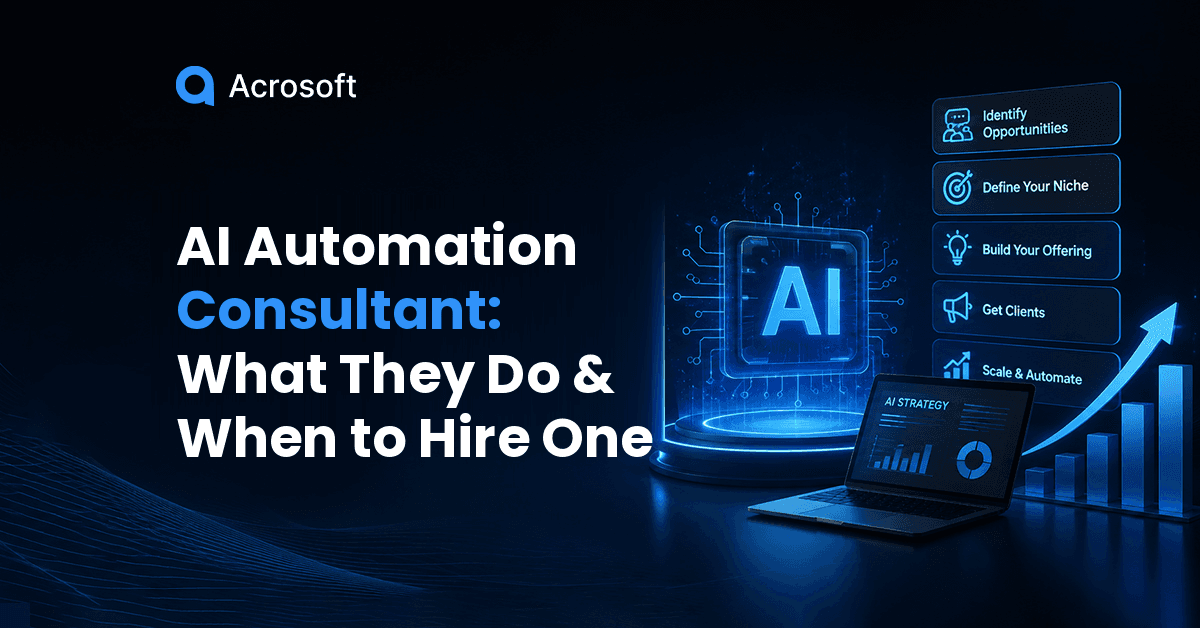
An AI automation consultant looks at how your business works, identifies where AI can reduce manual work, improve efficiency, or eliminate workflow slowdowns, and creates a prioritized plan before automation begins. Their role is to diagnose problems and recommend the right solutions, not simply install software. Most engagements include five stages: reviewing workflows and data, setting priorities, supporting implementation, training your team, and optimizing automations after launch.
That order matters. Businesses that skip the assessment and jump straight to buying tools usually end up with disconnected point solutions that nobody fully trusts. A consultant's real value is catching that problem before it costs you six figures.
What an AI Automation Consultant Does
The work breaks into distinct phases, and most reputable consultants package their services around them. Each phase produces a specific deliverable, not just advice.
The Workflow and Data Audit
The engagement starts with mapping your current processes: which tasks are manual, which tools already touch AI, and how clean your underlying data actually is. This step usually surfaces the gap between what leadership thinks is happening operationally and what teams are actually doing day to day.
The Strategy Workshop
Once the audit is done, the consultant runs a working session with department leads to rank opportunities by effort and impact. The output is a prioritized use-case list, not a generic slide deck of AI possibilities. Good workshops kill weak ideas here rather than letting them survive into a costly pilot.
Implementation Support
Some consultants build the automations themselves; others hand the roadmap to your internal team or a dedicated build partner. Either way, this phase turns the strategy into working systems, whether that is a customer-service agent, a document-processing pipeline, or a CRM integration.
Team Training
An automation nobody trusts gets ignored within a month. Training covers how the new tools work, what to do when they fail, and who owns troubleshooting. This is the step most agencies skip and most failed rollouts trace back to.
Ongoing Optimization
AI systems drift as your data and processes change. A consultant who sticks around post-launch monitors performance, retrains models or adjusts prompts, and folds new use cases into the roadmap on a regular cadence.
Is Your Business Ready for AI Automation?
Not every business benefits from AI automation consulting right now, and a consultant worth hiring will tell you that up front. Four factors determine readiness.
Data Quality
AI automation is only as good as the data feeding it. Gartner has found that a large share of organizations either lack, or are unsure they have, the right data management practices for AI, and the firm predicts that through 2026, organizations will abandon 60% of AI projects that are not backed by AI-ready data (Gartner, 2025). If your customer records live in three disconnected spreadsheets, that is the problem to fix before automating anything on top of them.
Team Buy-In
Automation projects stall when the people doing the work weren't consulted. A consultant should interview frontline staff, not just executives, before recommending anything.
Budget
Realistic budgets separate a useful engagement from a wasted one. Underfunding the implementation phase after paying for a strategy workshop is one of the most common ways businesses waste this spend.
Existing Tool Stack
If you already run five overlapping automation tools, a consultant's first job may be consolidation, not addition. Auditing what you have often uncovers licenses you're paying for and not using.
AI Use Cases by Industry
The right use cases depend heavily on the sector. McKinsey's 2026 global AI survey found that retail and consumer goods companies most often deploy AI agents in marketing and sales, while advanced manufacturers apply them to supply chain, inventory management, and production processes.
Retail and E-Commerce
Personalized product recommendations, inventory forecasting, and AI-assisted customer support tickets are the most common early wins. A consultant will typically start with support tickets, since the volume is high, the task is repetitive, and success is easy to measure in resolution time.
Professional Services and Finance
Document review, client intake automation, and AI-assisted research free up billable hours for higher-value work. Law firms and accounting practices tend to see the fastest payback from contract or invoice review, where a first-pass AI summary cuts hours off manual reading without replacing the final human sign-off.
Healthcare
Administrative automation, such as intake forms, scheduling, and claims processing, tends to move first, ahead of anything touching clinical decisions. Practices that automate scheduling and pre-visit paperwork usually see the return within a few months, since staff time is the direct cost being reduced.
Manufacturing
Predictive maintenance and supply chain visibility are where manufacturers see the fastest measurable return, consistent with what larger enterprises report industry-wide. A consultant here typically starts with a single production line or warehouse rather than a plant-wide rollout, so the data pipeline can be validated before scaling.
When to Hire an AI Automation Consultant
Three signals usually mean it's time to bring in outside help rather than continue experimenting internally.
Repetitive Tasks Are Piling Up
If your team spends hours each week on data entry, report generation, scheduling, or manual follow-ups, it may be time to look at automation. These repetitive tasks can take employees away from higher-value work and create avoidable delays. AI automation can help streamline routine processes and give your team more time to focus on work that requires human judgment.
Your AI Tools Don't Talk to Each Other
Many businesses adopt AI tools department by department. Marketing has one chatbot, support has another, and none of them share data. A consultant's audit usually catches this before you buy a sixth tool.
You Have No Internal AI Strategy
An AI consultant can help you build a clear strategy based on your business goals, workflows, and current technology. Instead of adopting AI tools without a plan, a consultant identifies practical use cases, sets priorities, and creates a roadmap for putting AI to work across your business.
What Happens When You Hire an AI Consultant?
A typical engagement starts with an assessment and roadmap that may take four to eight weeks. The exact timeline depends on your business needs, existing systems, and the complexity of the opportunities identified. Each stage builds on the previous one, moving from initial discovery to a clear implementation plan.
You Discuss Your Needs
The engagement begins with a short call to understand your goals, current challenges, and expected scope. It also helps confirm whether the consultant is a good fit before any paid work begins.
They Review Your Business
The consultant reviews your workflows, systems, and data to identify repetitive tasks and areas where AI could add value. This often includes team interviews and a review of your existing tools and processes.
You Get an AI Plan
You receive a prioritized roadmap outlining the most relevant AI use cases. Each recommendation typically includes estimated costs, timelines, implementation needs, and potential business impact.
The Plan Moves to Implementation
Once the roadmap is approved, the work moves into implementation. Some consultants build the automations themselves, while others work with an AI automation and implementation team to handle the buildout while continuing to provide strategic guidance.
What an AI Automation Consultant Costs
Pricing follows three common structures, and the right one depends on whether you need advice, a build, or both.
Engagement Type | Typical Cost | Best For |
Readiness Assessment | Free to a few thousand dollars | Confirming whether AI automation is worth pursuing yet |
Hourly or Project-Based Consulting | $80–$600/hour, or $10,000–$150,000 per project | Strategy, roadmap design, and vendor-neutral advice |
Monthly Retainer | $4,000–$15,000/month | Ongoing advisory support and ownership of AI decisions |
Rates climb with firm size. Independent consultants and boutique specialists typically bill toward the lower end of the hourly range, while large strategy firms charge substantially more for the same scope of work. Ask any consultant to quote by deliverable, not just by hour, so you can compare proposals on equal footing. A proposal that only lists hours with no named deliverable is the clearest sign you're paying for time, not outcomes.
How to Choose the Right AI Consultant
The right AI consultant should start with your business, not a list of AI tools. Look for someone who understands your workflows, has relevant experience, and can take your project from strategy to implementation.
Start With Their Approach
Ask how they assess your current processes and decide what is worth automating. A good consultant should connect each recommendation to a real business need rather than suggest AI simply because it is available.
Check Experience and Execution
Look at their previous work and confirm whether they can also handle implementation. Acrosoft, for example, combines AI consulting with automation and implementation support, helping businesses move from identifying opportunities to putting practical solutions into use.
Clarify the Scope
Before hiring, make sure you understand what you will receive, how long the engagement will take, who handles implementation, and what support is available afterward. This makes it easier to choose a consultant that fits your goals and budget.
The Bottom Line
The value of an AI automation consultant comes from the sequence: assess first, prioritize second, build third. Businesses that skip straight to buying tools tend to end up with disconnected systems and no way to measure whether any of it worked. If your team is buried in repetitive tasks, running disconnected AI tools, or has no documented AI strategy, an assessment is the lower-risk place to start. Get a free consultation to see where your business stands.
Frequently Asked Questions
A consultant typically focuses on assessment and strategy, while an agency builds and manages the automations. Some firms do both.