








Is your marketing telling one clear story or confusing your customers at every touchpoint? Your marketing is fragmented. Social says one thing. Email says another. Ads push something else. In the real world, this leads to confused buyers and lost revenue because your brand feels inconsistent across channels. This is what happens when enterprise teams work in silos.
Campaigns don’t connect, budgets get wasted and the customer journey breaks down. The solution is alignment. An integrated digital marketing strategy for enterprise brands brings all channels and teams onto the same page, ensuring your messaging stays consistent from first touch to conversion. In this guide, you’ll uncover what a high-performing, aligned marketing approach looks like, why it matters today, and how to build a strategy that delivers real results.
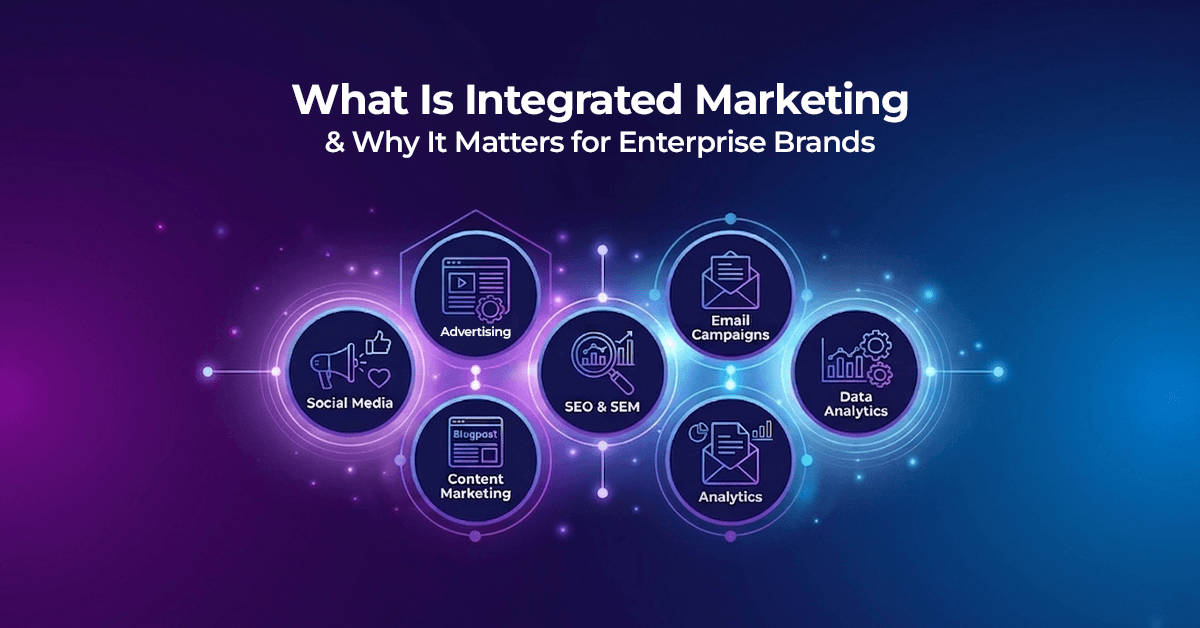
A cohesive marketing approach is the practice of aligning channels, messaging and teams around a single, consistent brand narrative. It ensures that every touchpoint works together rather than operating in isolation. Rather than running email, social, SEO, paid ads, and content separately, this approach integrates them into a single coordinated system. A customer might see an ad, visit your website and later receive an email.
When each interaction reinforces the same message, it builds clarity and trust. That’s the difference. While omnichannel marketing focuses on presence across platforms, a cohesive approach ensures everything stays aligned. And in a journey where customers engage multiple times before converting, consistency is what makes your brand memorable and credible.
Enterprise marketing is undergoing a fundamental shift. Customer journeys are no longer linear; they’re fragmented, dynamic and multi-touch. According to industry research, B2B buyers now engage with an average of 10+ touchpoints before making a purchase decision. In some enterprise-level deals, that number can exceed 20 interactions across digital and offline channels.
But many teams still don’t work together. Internal studies show that over 60% of marketing leaders struggle with disconnected data systems, and nearly 70% report inconsistent messaging across channels. The result? Wasted budget, misattributed performance, and a disjointed customer experience.
Multi-touch journey analysis consistently demonstrates that customers move fluidly between channels, search, social, email, direct, and paid media, before converting. Brands that fail to align messaging across these interactions risk losing trust. In fact, research from Salesforce indicates that 76% of customers expect consistent interactions across departments, yet more than half say it rarely happens. connected marketing directly addresses this gap. By aligning messaging, data and strategy across all touchpoints, enterprises can achieve.

Your paid media team optimizes for clicks. Your content team optimizes for engagement. Your email team optimizes for open rates. Each metric is tracked separately. No one sees the bigger picture. When teams operate in silos, they create conflicting messages. Your brand loses power because customers see inconsistency everywhere.
Enterprise marketing budgets are massive. But fragmentation kills efficiency. You're running duplicate campaigns across channels. You're missing cross-channel opportunities. You're not leveraging data to improve performance. Budget waste isn't just about spending more than necessary. It's about getting less return on every dollar spent.
If your channels don't integrate, how do you know which touchpoint actually drove the sale? You can't. Enterprise leaders need clear reporting. Fragmented systems make that impossible. Without proper attribution, you can't optimize spending. You're making decisions blindly.
Your website says one thing. Your ads say something else. Your email says something else entirely. Customers get confused. Trust erodes. Your brand weakens. Inconsistency compounds over time. Each touchpoint either reinforces your brand or undermines it.
Your customer data lives in multiple systems. Your CRM doesn't talk to your email platform. Your analytics don't connect to your ad platforms. Your insights stay fragmented. Without data integration, you can't personalize effectively at scale. You can't respond to customer behavior in real time.
Everything starts here. Define what your brand stands for, what problem you solve, and why customers should care. This message becomes the foundation. Every channel, every campaign, every piece of content flows from this central narrative. When your core message is clear, alignment becomes easier.
SEO isn't just about rankings. It's about reaching customers at critical decision points in their journey. Content strategy ties directly to SEO. You create valuable content that ranks. Then you amplify that content through paid channels, social media, and email. Each channel reinforces the others.
Paid advertising works harder when it's coordinated with organic efforts. Your paid campaigns should reinforce the same messages as your content. Your ad creative should match your brand guidelines. Your landing pages should align with your email copy.
Social media is where your audience hangs out. But social alone doesn't drive conversions at scale. Integrate social into your broader strategy. Use social to amplify content. Engage with customers. Build community. Then nurture those relationships through email and personalized experiences.
Email remains one of the highest-ROI channels for enterprise brands. But email works better when optimized. Segment your audience based on their behavior across all channels. Send personalized messages that continue the conversation they started on your website or in your ads.
You can't optimize what you don't measure. Integrate your analytics across channels. Build a unified view of customer behavior. Use that data to inform strategy decisions, content creation, and paid spending.
The best full-funnel marketing strategy includes sales. When sales and marketing alignment happens, lead quality improves. Your messaging resonates better because it's informed by real customer conversations. Handoff between marketing and sales becomes seamless.

When channels work together, you eliminate redundancy. You spend less to reach the same audience. Your cost per acquisition drops. Enterprise brands that integrate report better efficiency metrics. They spend less to achieve the same results compared to fragmented competitors.
Consistent messaging builds brand recognition faster. Your customers see the same message everywhere. It sticks. It builds authority. Over time, a cohesive marketing strategy strengthens your market position. You’re not battling for visibility, you’re establishing credibility and trust.
Unified systems provide unified data. You can finally see which touchpoints drive conversions. You can optimize based on real performance data, not guesses. Leadership gets the clarity they need. You can justify spending. You can optimize effectively.
Fragmented systems break as you scale. Integrated systems get stronger. When your strategy is built on coordination, adding new channels or campaigns becomes easier. You maintain consistency while expanding reach.
A connected marketing strategy is essential for sustainable growth.:
Your marketing channels operate independently
You can't clearly track which touchpoint drove the sale
Your brand message differs across channels
Your customer data lives in separate systems
Your teams don't communicate about strategy
Your budget feels misaligned with results
Even if just one of these applies to your organization, it's time to start thinking differently about how your marketing works. The earlier you integrate, the faster you'll see results. The longer you wait, the more inefficiency costs you.

Start with alignment, not tools. Get leadership and teams on the same message, positioning, and customer insights. Audit your channels and systems. Find where messaging breaks, data is siloed and teams lack coordination. Create a unified marketing calendar so all campaigns support the same story.
Centralize your data to give every team a clear view of the customer. Set shared goals and track performance across channels to measure what works. Keep teams aligned with regular reviews and continuous improvements. It is not a one-time fix. It is an ongoing process of better coordination and smarter execution.
Every day you operate with fragmented marketing, you're losing efficiency. You're leaving growth on the table. Enterprise brands that integrate today will dominate their markets tomorrow. They'll have better data. Better decision-making. Better results.
Integrated marketing is not a trend. It is a necessity for enterprise brands operating in a fragmented, multi-channel world. When your teams, channels, and messaging align, your marketing becomes more effective, your ROI improves, and your brand becomes easier to recognize and trust.
The real question is not whether to integrate, but how soon you start. Brands that move early gain clarity, efficiency, and a stronger market position. Those who delay risk falling behind. Start with the basics. Align your message, connect your data and coordinate your channels. Build from there.
Integrated marketing focuses on consistent messaging across all channels. Omnichannel marketing focuses on presence and seamless experience across those channels. In simple terms, it is about what you say, omnichannel is about where and how customers interact.
It typically takes 3–6 months to align teams, connect data and coordinate channels. Some early improvements can appear within weeks, but full integration is an ongoing process that evolves over time.
You need tools for automation, data management, analytics and team collaboration. The key is not the tools themselves, but ensuring they are connected and provide a unified view of your customer.
Track metrics like ROI, conversions, customer acquisition cost and engagement across channels. Compare performance before and after integration to see improvements in efficiency and consistency.