








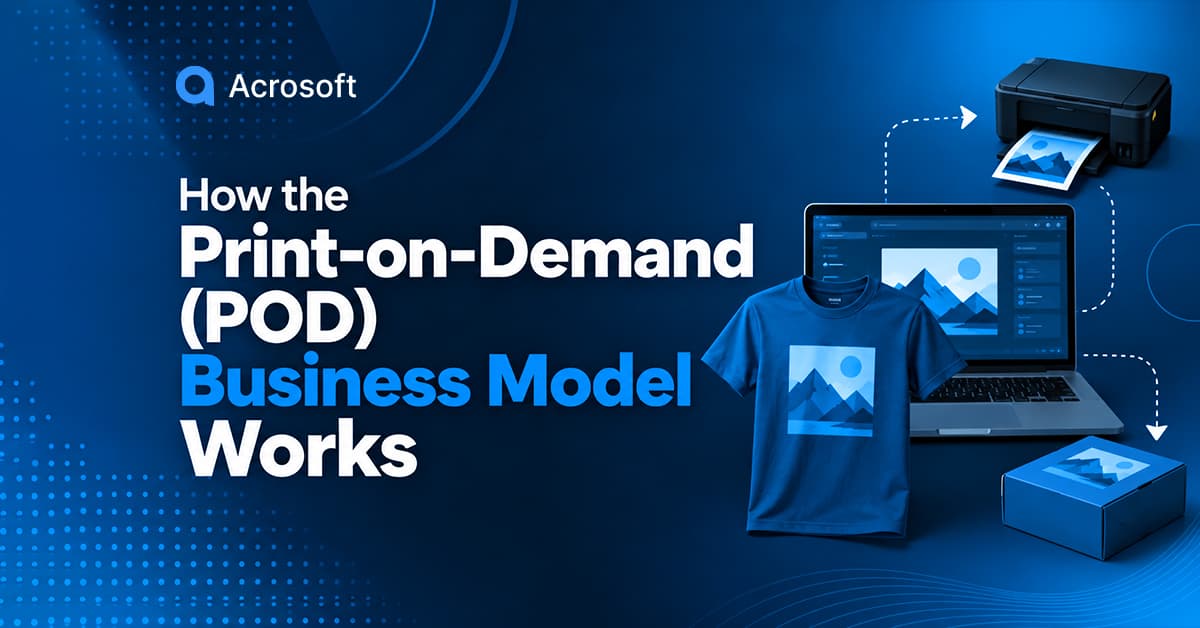
Blog Summary: To start a print-on-demand business in the USA, choose a specific niche, create original designs, select a reliable US-friendly POD supplier, list products on a marketplace or your own store, and set prices that cover costs and profit. Then market your products through SEO, social media, email, or paid ads. You can start with little upfront investment because products are made only after customers order.
Starting a print-on-demand business means selling custom products, like t-shirts, mugs, and hoodies, without holding any stock. You pick a niche. You upload designs. A supplier prints and ships each order after a customer buys it. This is one of the safest ways to open an online store today. Of course, a great product still needs buyers to find it. As your POD business grows, investing in digital marketing services can help turn early traction into consistent brand growth.
If you searched "how to start a print on demand business" and felt a bit lost, this guide will help. We break the process into simple steps you can follow today.
Print on demand, or POD, is a business model where products are created only after a customer places an order. In the USA, sellers can use POD suppliers to avoid investing in inventory or warehouse space and pay to make and ship each item only after it sells. This keeps upfront costs low and reduces the risk of unsold products.
Here is how it works, step by step:
You upload a design to a print-on-demand site like Printful, Printify, or Redbubble
You list the product in your store and set your own price
A customer buys it
Your supplier prints, packs, and ships the order to that customer
You keep the profit between your price and the base cost
This model is growing fast. A recent Print On Demand Market (2026 - 2033) Research says the global print-on-demand market was worth $10.8 billion in 2025. Analysts expect it to keep growing as more sellers choose custom, made-to-order products over bulk stock.
New sellers often design first and pick an audience later. Do it the other way around.
A niche is a group of people who share one clear interest. Think plant lovers, disc golf fans, or dog owners who also lift weights. The narrower your niche, the easier it is to write designs and ads that speak right to that group.
Try these steps to find a niche that fits:
Check Google Trends for topics you like. Is interest rising, steady, or falling?
Study bestsellers on Etsy and other POD stores. Look for gaps you can fill.
Start with something you already enjoy. It is hard to stay motivated selling a topic you do not care about.
Use keyword tools like eRank or Semrush to find search terms with real demand and light competition.
Once you pick a niche, every other step gets easier to plan.

Once you know your niche, the daily process of running a print on demand ecommerce store follows five simple steps.
This is where your brand starts to take shape. You do not need to be a trained artist. Most POD suppliers offer free design tools with templates and clipart. If you want a more polished look, a freelance designer on Fiverr or Upwork can turn your idea into a print-ready file within a few days.
Next, add your design to a product, like a shirt, mug, or tote bag, and publish the listing in your store. This is also where you write your title, description, and price. Take your time here. Rushing this step often hurts sales later.
A shopper finds your listing and checks out. Their payment covers the product cost, your profit, and shipping. You never touch the item or the box it ships in.
Your chosen supplier, such as Printful, Printify, or Redbubble, gets the order automatically. They print it, pack it, and ship it straight to your customer. Most orders leave the warehouse within two to five business days.
Once the order ships, you keep the margin you built into your price. There is no leftover stock and no storage cost to worry about.
This five-step loop repeats for every sale. It runs on its own once your store connects to your supplier. That is print-on-demand automation, and it is why this model suits beginners running a store part time.
Not every print-on-demand supplier fits every niche. It helps to compare a few before you commit.
Printful makes most items in-house at its own facilities. This means steadier quality and fewer surprises. It connects with Shopify, Etsy, WooCommerce, and most major platforms. It also offers branding extras like custom labels and packing slips.
Printify works with more than 140 third-party print partners worldwide. This gives you the widest product catalog in the industry. Base prices are often lower too. It is a strong pick if you want more product variety without tying yourself to one manufacturer.
Redbubble works differently. It is a marketplace, not a supplier you connect to your own store. You upload designs, and Redbubble handles the listing and traffic. You get less control over price and branding than you would with Printful or Printify.
Printful and Printify joined a shared parent company, FYUL, according to a report from Print Monthly, though each platform still runs independently for sellers. This shows how much investment is flowing into the print-on-demand space right now, which is good news for the tools and support available to new sellers.
Always order a sample before you launch. Check the fabric, the print quality, and the packaging. That is exactly what your customer will see and feel.
You have three main paths for where to sell print-on-demand products, and you do not have to pick just one.
Marketplaces like Etsy, Amazon, and eBay put you in front of shoppers who are already searching. You skip the slow work of building traffic from scratch. But you get more competition and less control over your brand.
Your own online store can run on Shopify, WooCommerce, or a custom site. It gives you full control over branding, pricing, and the buying experience. It takes more setup work. But it is the stronger choice if you want to build a lasting brand. A fast, well-built store also matters more than most beginners expect. A slow or clunky site quietly loses sales, no matter how good your designs are. So before you launch, it's worth turning to a proper Website Development team instead of losing sales to a slow site later.
Automation tools and APIs connect your store to your supplier. Orders sync and fill without manual work. Most beginners will not need this level of setup right away. It becomes useful once order volume grows.
Start with the channel that fits your budget and comfort level. Add more once you prove a product sells.
Pricing print-on-demand products takes math and a bit of strategy. Start with the math.
Add up your full cost per item: base production price, shipping, and any platform fees
Add a profit margin. Most sellers aim for 20% to 50%, depending on the product
Check what similar stores in your niche charge, so you are not priced too high or too low
If you plan to offer free shipping, build that cost into your price instead of covering it separately
Pricing does not need to stay fixed forever. But avoid changing it too often. Steady prices build trust with repeat buyers. Test changes on purpose. Give them time to show results before you adjust again.
Great designs do not sell themselves. A clear print-on-demand marketing plan turns a finished store into real income.
Focus on a few channels instead of trying to do everything at once.
Social media, especially Instagram, TikTok, and Pinterest, works well for visual products like apparel and drinkware
Email marketing brings past buyers back for new drops and seasonal sales
SEO helps your store show up in search long after you stop actively promoting it
Small paid ad tests on Meta or Google can show you which designs are worth scaling before you spend big
If search traffic matters to your store, it helps to know where your listings stand against competitors. So before you spend time or ad budget guessing, check out our guide, How to Do an SEO Competitor Analysis, to see exactly which keywords and content gaps are worth chasing first.
A few patterns show up again and again with new sellers.
Launching too many products at once. A small, focused collection gives you cleaner sales data than a store with fifty untested designs.
Skipping the sample order. Print quality and fit vary by supplier. Always check before your customers do.
Ignoring shipping timelines. POD orders take longer to arrive than stocked items, so set clear expectations on your store.
Copying other designs too closely. Original artwork, even simple text designs, builds a brand people remember.
Picking a supplier and uploading designs is the easy part. The harder part is building a store that loads fast, ranks in search, and turns visitors into buyers in the USA market. That is where many new print-on-demand sellers lose momentum. A digital partner like Acrosoft can help by building custom storefronts, creating SEO-driven content, and planning marketing strategies that turn a POD side project into a lasting brand.
Maybe you need a store built from scratch. Maybe you need an old shop tuned up for speed and sales. Either way, solid fulfillment plus solid digital support is what separates stores that stall from stores that grow.
No. Most beginners start as a sole proprietor. You can register a business later once sales become steady. Rules vary by state and country, so check yours first.
Many sellers launch with $0 to $50. That often covers just a listing fee or a domain name. Production only starts after a sale, so there is no big upfront cost.
Yes, though profit depends on your niche, pricing, and marketing. Sellers with a clear brand and a defined audience tend to do better than stores that sell generic designs.
Printful makes products in-house with steady quality. Printify offers the widest product catalog through outside partners. Redbubble is a marketplace. It handles traffic and listings for you, but you get less control over branding.
Yes. Fulfillment runs on its own, so many sellers start a POD store next to a full-time job. They grow it over time.
This varies. Most sellers see early traction within one to three months of steady listing work and marketing. Marketplaces with built-in search traffic tend to work faster.