






Social Media Marketing Services and Strategies for Your Business
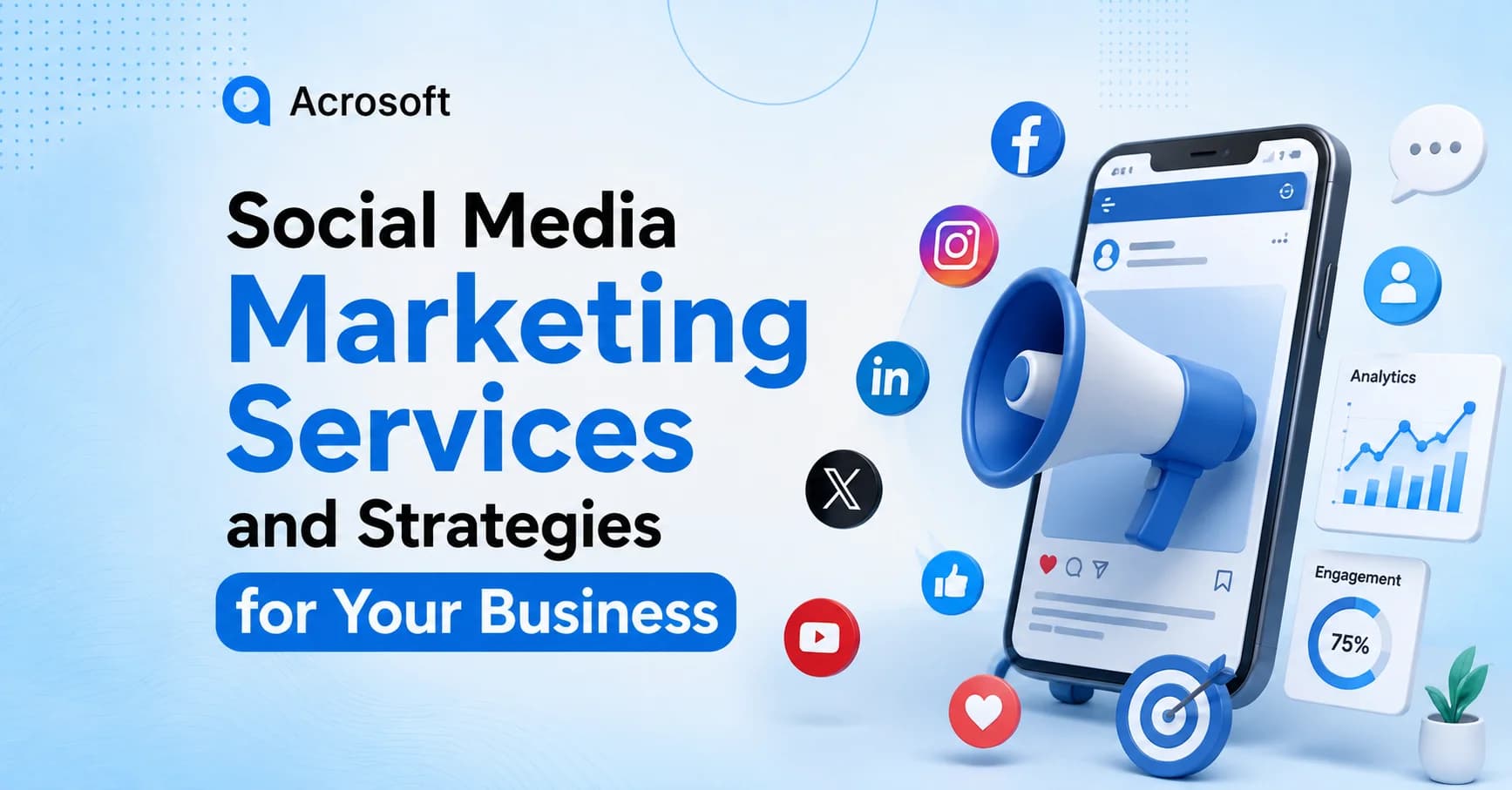
Social media marketing covers several distinct strategies, each designed to achieve a different business goal. Organic content builds visibility and trust, paid social advertising reaches targeted audiences, community management strengthens relationships, influencer marketing expands reach, social commerce drives sales, and analytics helps measure what works.
Most businesses do not need to use every strategy equally. The right mix depends on your goals, audience, budget, and growth stage. The sections below explain how each approach works and how they can work together as part of a complete social media marketing plan.
Organic Social Media Content
What Counts as Organic Content?
Organic content is anything you post without paying to boost it: photos, videos, captions, polls, and stories that reach people because they already follow you, not because a platform charged you for the placement.
Why Is Organic Reach Shrinking?
Fewer people see organic posts than they used to, and the drop has been steep. According to Hootsuite, Facebook's average organic reach has fallen from around 16% in 2012 to roughly 1 to 2% today, and Instagram and LinkedIn have both seen sharp drops in just the past year. Two things are driving this: platforms now sell the reach they used to give away, and every feed is more crowded than it was a decade ago, so even a neutral algorithm would show your posts to fewer people.
When Does Organic Content Still Earn Its Place?
Organic content pulls its weight when the goal is trust rather than speed. It's the cheapest way to test messaging, build a recognizable voice, and give paid ads and influencer content somewhere credible to point back to. A brand-new account running only paid ads tends to convert worse than one with an active, believable organic presence behind it.
Paid Social Advertising
How Is Paid Social Different From Boosting a Post?
Paid social covers any content you pay to place in front of a chosen audience, whether they follow you or not: feed ads, story ads, retargeting campaigns, and boosted posts across platforms like Meta, TikTok, LinkedIn, and Pinterest. Boosting a single post is one small piece of this; most paid social budgets go toward campaigns built around a specific audience and objective, not one-off boosts.
Why Have Marketers Shifted So Much Budget Toward Paid?
As organic reach has thinned out, paid social has become the fastest way to guarantee a specific audience actually sees your content. eMarketer's US Social Network Ad Spending Forecast Report projects U.S. advertisers will spend more than $121 billion on social networks in 2026, a sign of how much budget has moved from hoping people find you organically to simply buying the visibility outright.
Where Does Paid Social Fall Short by Itself?
Ads perform worse when they point to a thin or inactive profile. Paid social works best layered on top of a page that already looks credible, which is one reason it rarely replaces organic content entirely, even for brands with large ad budgets.
Community Management
What Does Community Management Actually Involve?
Community management is the ongoing work of answering comments, direct messages, reviews, and mentions. It's less visible than posting content, but it shapes whether a brand feels responsive or automated.
Why Does a Slow Reply Cost More Than a Missed Ad?
A public complaint that goes unanswered is visible to everyone who scrolls past it, not just the person who wrote it. A generic or delayed response can do more damage to a brand's reputation than a paused ad campaign ever would, because the exchange sits on the page permanently for anyone else to find.
When Does This Become a Dedicated Job Instead of a Side Task?
Once comments and messages arrive faster than one person can track between other duties, community management needs its own owner. This is also where product feedback tends to surface first, long before it shows up in a formal survey or support ticket.
Influencer Marketing
What Makes Influencer Marketing Different From an Ad?
Influencer marketing means paying or partnering with a creator who already has an engaged audience to feature your product. Where an ad interrupts someone's feed, a creator's post arrives inside a relationship the audience already trusts, which is a large part of why the format performs the way it does.
Why Are Smaller Creators Starting to Outperform Big Names?
Industry estimates put the global influencer marketing industry at around $32.55 billion in 2025, on track to pass $40 billion in 2026, and much of that growth is happening at the smaller end of the market. Micro-creators with tighter, more engaged niche audiences are increasingly delivering better engagement than accounts with far larger followings, since a smaller audience is often a more attentive one.
How Do You Know You're Ready for This Type of Partnership?
Influencer marketing works best once you already know who your audience is and what they respond to. Brands entering a new market segment or trying to earn trust from an audience that doesn't know them yet tend to get the most out of it.
Social Commerce
How Does Social Commerce Change the Path to Purchase?
Social commerce lets someone buy a product without leaving the app, through shoppable posts, in-app checkout, live shopping, and native storefronts on platforms like Instagram, TikTok, and Facebook. It removes the extra step of clicking through to a separate website, which is where a lot of potential buyers otherwise drop off.
How Big Has This Category Actually Gotten?
Sales through social networks were estimated to account for about 15% of total online sales in 2026, a share that keeps climbing each year as more platforms build out native checkout and live shopping features.
Does Social Commerce Work Without the Other Types Behind It?
Not well on its own. A shoppable post still needs an audience to find it, whether through organic reach, paid placement, or a creator partnership. Social commerce performs best as the final step in a path that another type of marketing already built.
Analytics and Reporting
What Should You Actually Be Tracking?
Analytics and reporting cover engagement rates, click-through rates, conversion rates, cost per result, and audience growth across every channel above. Without it, none of the other five types can tell you whether they're working or just producing activity.
Why Do Most Businesses Ignore This Until Something Breaks?
Reporting doesn't produce visible content, so it's easy to deprioritize compared to writing the next post or launching the next campaign. That trade-off usually backfires: by the time a campaign is obviously underperforming, the budget behind it is already spent.
When Is a Dedicated Reporting Tool Worth Adding?
Platform-native analytics cover a single channel well enough on their own. A separate reporting tool starts to earn its cost once you're comparing performance across more than one platform or need to justify spend to someone outside the marketing team.
Matching the Right Mix to Your Business
How Do These Six Types Compare Side by Side?
Type | Best for | Typical cost | Time to see results |
Organic content | Brand awareness, trust | Low (time investment) | Slow (weeks to months) |
Paid social | Fast reach, lead generation | Medium to high | Fast (days) |
Community management | Reputation, retention | Low to medium | Ongoing |
Influencer marketing | Borrowed trust, new audiences | Medium to high | Medium (weeks) |
Social commerce | Direct sales | Low setup, ongoing platform fees | Medium |
Analytics and reporting | Measuring what works | Low to medium | Immediate insight, delayed action |
In What Order Should a New Brand Add These?
Most brands start with organic content and community management to build a foundation, since both mainly cost time rather than ad budget. Paid social usually comes next, once there's something worth promoting. Influencer marketing and social commerce tend to work best once the audience and product fit are already proven, since both perform better with an established presence behind them.
Should You Run This In-House or Bring In Outside Help?
That depends less on which types exist and more on your budget, your timeline, and how much of this your team can execute consistently every week. If you're weighing that decision, how to choose the right social media marketing agency breaks down what to look for, what it typically costs, and how to evaluate return on investment.
Mistakes That Quietly Undercut a Social Media Plan
Running paid ads with no organic presence behind them. Ads pointing to a sparse or inactive profile convert worse than ads pointing to a credible, active one.
Treating an influencer partnership as a one-time transaction. A single sponsored post rarely outperforms an ongoing relationship with the same creator.
Putting off analytics until a campaign is obviously failing. By the time the numbers force the conversation, the budget behind it is usually already spent.
Assuming community management can wait until the following grows. Even a handful of unanswered comments signals that no one is paying attention.
Adding social commerce before there's an audience to sell to. A shoppable post still needs traffic and trust behind it, or the conversion rate will disappoint.
Conclusion
Social media marketing works best as a set of tools you choose from deliberately, not a checklist you try to complete all at once. Start with the types that match where your brand is right now, track what's actually moving the needle, and add complexity only when there's a clear reason to.
If you'd rather have a team build and manage that mix for you, Acrosoft's social media marketing services cover strategy, content, paid campaigns, and reporting under one plan built around your goals.
Frequently Asked Questions
There isn't one universally best type. Paid social produces the fastest measurable results, while organic content and community management build the trust that makes paid campaigns and influencer partnerships convert better. Most effective strategies combine at least two or three types rather than relying on one.