








SEO for Financial Advisors: How to Get Found Locally
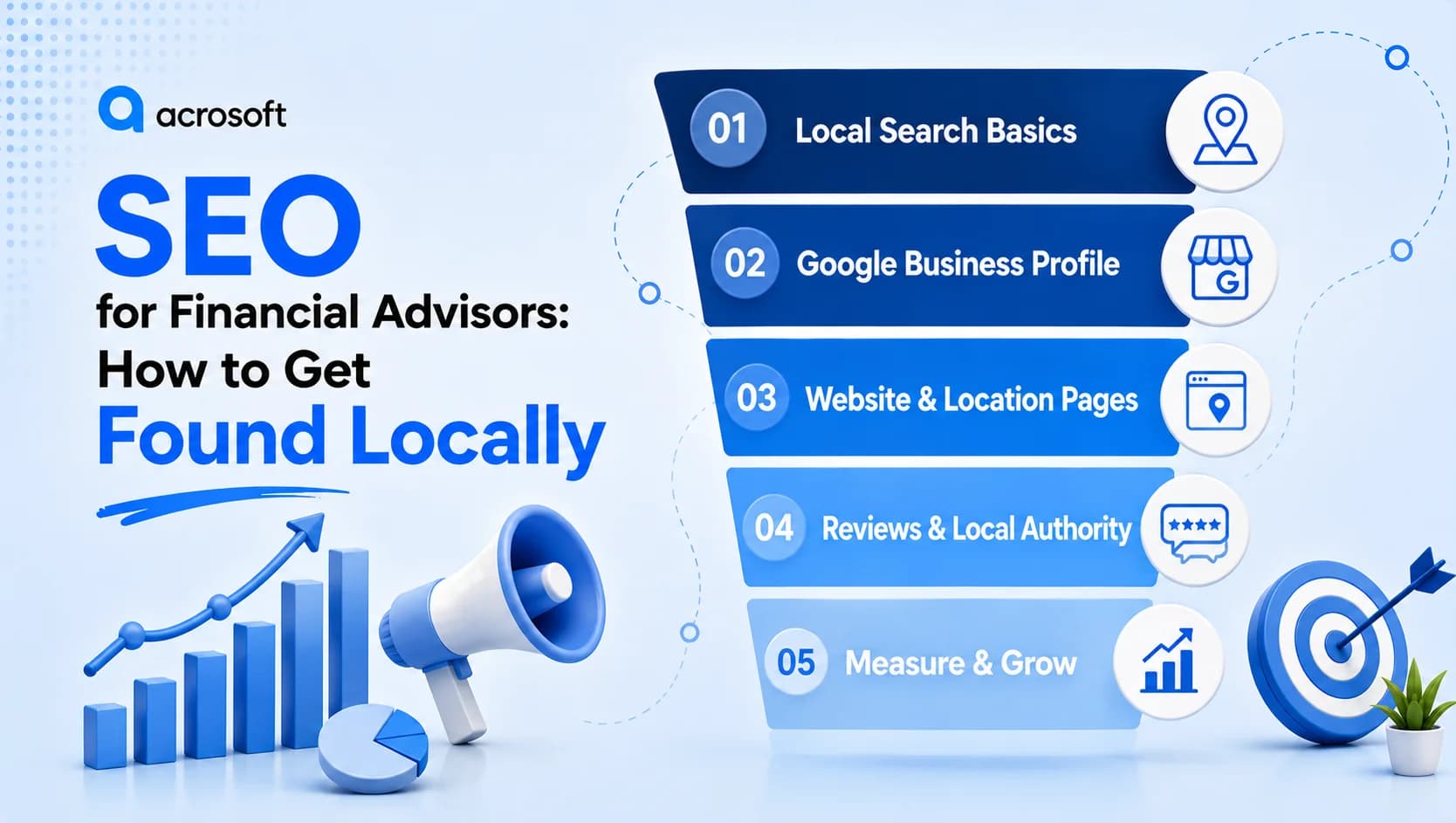
SEO for financial advisors is the practice of making your firm visible when people search for financial help in a specific area. The core pieces are a well-built Google Business Profile, a website with clear service and location pages, steady reviews, consistent listings, and credible local mentions. Together, they tell Google who you are, what you do, and where you do it.
This matters because a search like a retirement planner in Denver already carries a place and a need. The goal is not raw traffic. It is appearing in front of nearby prospects who are ready to talk. Nobody can promise rankings or clients, but you can control the signals that earn visibility. This guide is educational, not financial or legal advice.
Why Do Local Searches Matter So Much for Financial Advisors?
Financial advice is a trust decision. Before anyone books a call, they want proof that you are real, nearby, and a fit. Local search answers many of those questions before you ever speak to them.
What the prospect wonders | Where local search answers it |
Is this firm real? | Google Business Profile, address, photos |
Do they serve my area? | Location details, service area, local pages |
What do they do? | Service pages, profile categories |
Who will I meet? | Advisor bios, credentials, photos |
Do clients like them? | Reviews and responses |
Every gap in that table is a reason to click a competitor. The rest of this guide closes them.
What Signals Decide Whether You Appear in Local Results?
Google says local results are based mainly on relevance, distance, and prominence. Each one maps to work you can do.
Relevance: Does Your Firm Match the Search?
Relevance comes from how clearly your profile and website describe your services. "Wealth management for physicians" gives Google more to match than "comprehensive solutions."
Distance: How Close Are You to the Searcher?
You cannot change where a searcher stands, but an accurate address, service area, and hours help Google place you correctly.
Prominence: How Well Known and Trusted Are You?
Prominence reflects reviews, links, mentions, and overall web presence. Local SEO is never one tactic: your profile, site, reviews, and citations should all describe the same business the same way.
Which Keywords Should a Financial Advisor Target Locally?
Skip the broad term financial advisor. It is crowded and vague. Build keyword targets from three patterns instead:
Service plus place: financial planner in Austin, wealth management in Austin.
Intent plus service plus place: fee-only retirement advisor in Austin.
Problem plus place: retirement income planning in Austin.
Start from the services you actually provide, then check which phrases prospects use. Google's autocomplete, the People also ask box, and Search Console queries are good free sources. Give a term its own page only when you have something distinct to say. One strong page per real service beats ten near-identical ones.
How Should You Set Up Your Google Business Profile?
Your profile is often the first thing a local prospect sees, so treat it as a core asset. Follow Google's guidelines rather than trying to game them.
Use your real business name. Adding keywords to the name violates the guidelines and can get the profile suspended.
Pick an accurate primary category, such as Financial Planner, and add secondary categories only if they describe real services.
Keep your phone, website, hours, and address identical to what appears on your website.
Add your services, photos of your office and team, and a plain-language description of who you help.
What If You Meet Clients Remotely?
Google generally requires in-person contact with customers during stated hours, so a virtual-only setup may not qualify for a Maps listing. Confirm eligibility first. Advisors without a qualifying office can still rank in regular organic results through their website.
What Should Your Website Prove to Local Visitors?
Your profile earns the click, but your website decides whether visitors trust you and see themselves as your clients.
Service Pages That Say Who You Help
Each core service, such as retirement planning or investment management, deserves a page that names the audience, explains your process in plain language, and shows how to book a consultation. Link these pages together so visitors and Google see how your services connect.
Location Pages That Earn Their Place
A location page makes sense if you have an office in an area or genuinely serve clients there. A useful one covers the office address, the services offered, the type of client you help, and real local context, such as the professional communities you serve.
A thin page swaps only the city name across a template. Google's spam policies treat mass-produced pages like this as doorway pages. If you cannot write something genuinely different for a location, do not publish it.
Advisor Bios and Trust Signals
Money is a high-stakes topic, so visitors need evidence of who is behind the advice. Show each advisor's photo, background, credentials, and licenses, and make sure every one is accurate and verifiable. A credential alone does not prove expertise, so pair it with plain explanations of how you work. Add the disclosures and regulatory information your compliance team requires, and name the reviewer on educational articles.
Mobile Experience and Speed
Many local searches happen on a phone. Make your number tap-to-call, keep the booking link visible without scrolling, and avoid slow, heavy pages. Search Console's Core Web Vitals report shows what needs work.
Is There a Trick to Ranking for Near Me Searches?
No. Google infers local intent from the searcher's location and from your profile, website, reviews, and reputation. Repeating a financial advisor near me on a page reads poorly and does nothing useful. Get your location details right and let the signals work.
How Do Reviews Help, and How Do You Handle Them Safely?
Reviews shape both rankings and the decision to call. BrightLocal's Local Consumer Review Survey 2026: Star Ratings Keep Rising, Old Reviews Don't Cut It surveyed 1,002 US adults and found a rising bar. It reports that 31% would only use a business rated 4.5 stars or higher, up from 17% the year before, and that 47% will not use a business with fewer than 20 reviews. It also found that 74% care only about reviews from the last three months, and that 89% expect owners to respond. These are general local-business figures, not financial-services data, but they show where expectations are heading.
For advisors, this means review collection should be steady, not a one-time push. Some rules apply on top of that:
Ask real clients, and make it easy. Send a direct link after a positive meeting.
Never buy or write fake reviews. The FTC's 2024 rule makes fake reviews illegal, and Google prohibits offering incentives for them.
Protect confidentiality in replies. Do not confirm someone is a client or mention any account details. A safe reply thanks the reviewer and invites them to call.
Check the compliance rules. The SEC Marketing Rule permits testimonials and endorsements only under specific conditions, and broker-dealers face FINRA advertising rules. Ask your compliance officer how they apply to reviews before running a review campaign.
Prospects also no longer rely on Google alone. The survey shows Google's use for reviews fell from 83% to 71%, while AI tools for local recommendations jumped from 6% to 45%. Keep your details consistent on Apple Maps, Bing, and professional directories too.
Where Do Citations and Local Links Fit In?
Citations and links build the prominence signal, and quality beats volume.
Citations: Consistency Over Quantity
A citation is a mention of your firm's name, address, phone number, and website. Keep them identical everywhere. Prioritize listings a prospect, or Google, would actually trust: your chamber of commerce, membership directories from bodies such as the CFP Board or NAPFA if you qualify, and respected local business directories. Skip mass submissions to low-quality directories.
Local Links: Earn Them by Being Useful
Links follow real activity. Sponsor a community event, host a free retirement workshop with a local business group, or give an expert comment to a regional publication. Each earns a legitimate mention from a relevant source. Never buy links or join link schemes, which risk penalties.
What Local Content Is Actually Worth Publishing?
Skip city-name-swapped articles. Combine a financial question, a specific audience, and local context:
Questions to ask before hiring a financial advisor in your city
Financial planning considerations for small business owners in your area
Preparing for retirement if you are relocating within your region
Avoid claims about local tax rules, market outcomes, or regulations unless you can cite an official source, and never present content as personal advice.
Should You Add Structured Data to Your Site?
It is optional, but it can help. Structured data is code that labels page information so search engines read it correctly. For a firm, that usually means LocalBusiness markup with your name, address, phone, and hours, plus Person markup for advisors, all matching what visitors see. It does not guarantee rankings or rich results, and Google does not require it for AI features. Treat it as housekeeping, and test it with Google's Rich Results Test.
How Do You Measure Local SEO Beyond Rankings?
Rankings are a leading indicator, not the goal. What matters is calls, direction requests, form submissions, and booked consultations. Track Google Business Profile actions alongside website conversions, and ask every new prospect how they found you. For a full framework on cadence and reporting, see Acrosoft's SEO Tracking: How to Measure and Report SEO Performance.
Which Quiet Mistakes Undermine Local SEO for Financial Advisors?
Some errors do not look like SEO problems but still cost you trust:
Performance promises. Phrases like beat the market or guaranteed returns create compliance risk and hurt credibility.
Generic AI-written articles. Financial content published without an advisor's review is thin and can contain errors.
Pages for services you do not offer. A page built only to catch a keyword invites the wrong inquiries.
Set-and-forget profiles. A departed advisor or outdated hours quietly erode trust.
What Does a Practical 90-Day Plan Look Like?
Days 1 to 30: Audit your profile, fix inconsistent details, and list your real services and target areas.
Days 31 to 60: Rewrite core service pages, add location pages only where justified, and start a review-request routine.
Days 61 to 90: Claim quality citations, pursue a local partnership, publish one helpful local article, and set up tracking.
Expect gradual gains. No timeline is guaranteed.
Ready to Get Found by Local Clients?
If you want a local SEO plan built around your services, your market, and your compliance limits, Acrosoft can handle it. Our team's SEO Services in the USA cover keyword research, technical fixes, content, and authority building. Book a consultation with Acrosoft today and get a clear roadmap for turning local searches into qualified consultations.
Frequently Asked Questions
They do different jobs. Ads bring inquiries quickly but stop when the budget stops. SEO takes longer but compounds. Many new firms run a small ad budget for early leads while building local SEO.