










MVP in Agile: What It Is, How to Scope One and Real Examples
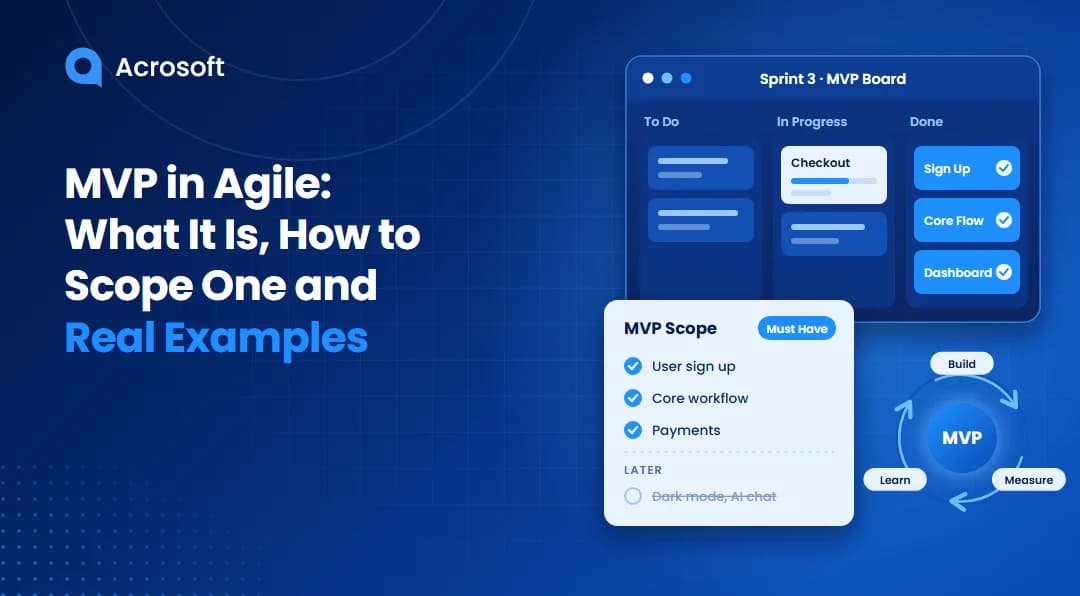
An MVP (Minimum Viable Product) in Agile is the smallest working version of a product that lets your team test its riskiest assumption with the people it is built for. It is a learning tool first. You build it in short sprints, release it to a small group, and use what you learn to choose the next backlog items.
A good MVP solves one problem for one type of user. It works well enough that people trust it, and it comes with a clear rule for what success looks like. Below you will find how the MVP fits into sprints, a six-step scoping method, a worked example, and four famous MVPs with the assumption each one tested.
What Does an MVP Mean for an Agile Team?
Think of the MVP as a question you can hold in your hand. The question might be “Will busy parents book tutoring online?” or “Will finance teams pay to automate invoice matching?” The product exists to get an answer you can trust, based on what people do rather than what they say.
Where the Idea Came From
Eric Ries popularized the term in The Lean Startup. His definition centers on learning: an MVP is the version of a new product that lets a team gather the most validated learning about customers with the least effort. Notice what that definition leaves out. It says nothing about a feature count, a launch date, or a polished interface.
Agile teams adopted the idea because it fits how they already work. Scrum, Kanban, and other Agile frameworks run on short feedback loops, and the MVP gives those loops a sharp purpose.
Why “Viable” Is the Word Most Teams Ignore
“Minimum” gets all the attention. “Viable” does the heavy lifting.
Viable means a user can finish the core task without help, and the experience is good enough that their behavior tells you something. If people quit because the app crashes or the checkout feels unsafe, you learn nothing about demand. You only learn that the product was broken. So trim features freely, but make sure the one path you do offer works every time.
How Does an MVP Fit Into Sprints and the Product Backlog?
Many guides skip this point: the Scrum Guide doesn’t use the term MVP at all. Scrum talks about a Product Goal, a Product Backlog, and an Increment, which is the usable, “Done” work produced each sprint. The MVP is a product strategy idea that sits on top of that structure.
In practice, the MVP becomes a near-term product goal. The Product Owner orders the backlog so that every sprint moves toward a releasable version that can test the main assumption. Sometimes one increment is enough to reach an MVP, and sometimes it takes many. At each Sprint Review, the team and stakeholders ask one question: is what we have now enough to learn from actual customers? If yes, release it. If no, keep building toward it.
MVP vs. Increment vs. Prototype vs. Minimum Marketable Product
These terms get mixed up in meetings all the time, so here is a quick comparison.
Term | What It Is | Who Sees It | What It Answers |
Prototype | A clickable or visual model, often without working code | Internal team and test users | Can people understand and use this design? |
Proof of Concept (PoC) | A technical experiment | Engineers and decision makers | Can we build this at all? |
Increment | The “Done” output of one sprint | The Scrum team and stakeholders | Did we build this sprint’s work properly? |
Minimum Viable Product (MVP) | The smallest working product that tests a market assumption | Early adopters | Will people use or pay for this? |
Minimum Marketable Product (MMP) | The first version ready for a broad public launch | The full target market | Can we sell this at scale? |
The takeaway: a prototype tests usability, an MVP tests demand, and an MMP tests the market at scale. Teams that skip the prototype stage often find usability problems inside their MVP, and those problems muddy the demand signal. That is why many teams start with prototyping services before writing production code.
Why Is Scoping the Hardest Part of Building an MVP?
Scoping is hard because every stakeholder has a favorite feature, and each one sounds reasonable on its own. Add them all up and the “minimum” product takes nine months.
The cost of guessing wrong goes beyond wasted sprints. In its report on the top 9 reasons startups fail, CB Insights examined 431 venture-backed companies that shut down since 2023. Running out of capital topped the list at 70%, but the firm notes that cash is usually the last cause of death rather than the root problem. Poor product-market fit showed up in 43% of the cases. A tightly scoped MVP addresses both problems at once: it spends less money, and it finds out sooner whether the market wants what you are building.
How Do You Scope an MVP in Agile? A Six-Step Method
This method works for startups and for new products inside larger companies. Each step produces something concrete your team can put on the wall or in the backlog.
Step 1: Write Down the Riskiest Assumption
Every product idea rests on a stack of assumptions. Find the one that would kill the idea if it turned out to be false. Then write it as a testable hypothesis:
“We believe [type of user] will [specific behavior] because [reason]. We will know we are right when [metric] reaches [threshold] within [time frame].”
If you cannot fill in the metric and threshold, you are not ready to build yet.
Step 2: Set Success and Stop Criteria Before Sprint One
Decide in advance which result means “continue,” which means “change direction,” and which means “stop.” Teams that skip this step tend to declare success no matter what the numbers say. Agreeing on the thresholds early keeps the Sprint Review honest.
Step 3: Map One Core User Journey
Use user story mapping. Lay out, from left to right, the steps a user takes from first contact to getting value. Then draw a line under the thinnest slice that still completes the journey from start to finish. Engineers sometimes call this a “walking skeleton”: every layer of the system exists, but each one is as thin as possible.
Step 4: Sort Features Into Build, Fake, and Later
Most teams sort features with MoSCoW (Must have, Should have, Could have, Won’t have this time). That works, but add one more question for every “Must have”: can a person do this by hand for the first 50 users? If yes, fake it. A founder can send confirmation emails manually, approve accounts from a spreadsheet, or match orders behind the scenes. This “fake” column is where most of the time savings come from.
Step 5: Fix the Time and Let Scope Flex
Choose a fixed number of sprints for the first release. When new ideas show up mid-build, and they will, they go to the backlog below the MVP line. The deadline stays put. The scope moves.
Step 6: Protect the Quality Floor
Write a Definition of Done that covers the non-negotiables: security, data privacy, payment safety, and basic accessibility. Cutting these does not make an MVP leaner. It makes the results unreliable and can create legal risk, especially in healthcare and finance.
A Worked Scoping Example: Online Booking for a Physical Therapy Clinic
To make the method concrete, here is a hypothetical scenario. A small chain of physical therapy clinics wants an app for booking appointments, and the wish list has 14 features.
The riskiest assumption: existing patients will book follow-up visits online instead of calling the front desk. The success rule: at least 30% of follow-up bookings move online within six weeks of launch.
Feature | Decision | Reason |
See open slots and book a visit | Build | This is the behavior being tested |
Text message (SMS) reminders | Build | No-shows would distort the results |
Secure patient login | Build | Health data needs protection from day one |
Insurance verification | Fake | Front desk staff check it manually for now |
Rescheduling | Fake | A “call us to reschedule” link covers it |
Therapist profiles with videos | Later | Nice to have, but it doesn’t test the assumption |
In-app payments | Later | Patients already pay at the clinic |
Native iPhone and Android apps | Later | A mobile-friendly web app tests the same behavior |
The table shows eight of the 14 requests; the other six were dropped in the first review. Only three get built, and that is the point of scoping. The clinic can now launch in a few sprints and learn whether patients will book online at all. If they will, a team offering app development services can turn the winning flow into native apps, with evidence behind the investment.
Real MVP Examples and What Each One Tested
Most articles list famous MVPs as inspiration. It is more useful to look at the single assumption each one tested, because that is the part you can copy.
Dropbox: A Video That Tested Demand
Drew Houston did not build the full syncing product first. He recorded a short demo video showing how Dropbox would work and shared it with a tech-savvy audience. Houston later recalled that the beta waiting list grew from 5,000 to 75,000 people overnight. The assumption tested: do people want effortless file syncing badly enough to sign up? No infrastructure was needed to find out.
Zappos: A Manual Store That Tested Online Shoe Buying
Zappos started with a “Wizard of Oz” MVP. Customers thought the process was automated, while employees were actually running to shoe stores behind the scenes. The assumption tested: will people buy shoes without trying them on? The answer came before any warehouse existed.
Buffer: A Landing Page That Tested Willingness to Pay
Joel Gascoigne founded Buffer in 2010 as a simple way to schedule tweets. Before building it, he put up a landing page describing the tool. In a second version, he added a pricing page in the middle, so visitors had to choose one of three plans before reaching a page saying the product wasn’t ready yet. That extra step changed the question from Is this interesting? to Would anyone pay for this?
Airbnb: Air Mattresses That Tested Trust Between Strangers
In 2007, the founders rented out air mattresses in their San Francisco apartment to visitors during a busy design conference. The assumption tested: will strangers pay to stay in someone’s home? It took one listing, a basic website, and paying guests.
Look at the pattern. None of these MVPs was a shrunken version of the final product. Each one was the cheapest honest test of one risky belief.
What Should You Measure After the MVP Ships?
Measure behavior tied to your hypothesis instead of vanity numbers. Page views and downloads feel good, but they rarely answer the question you started with.
Three signals usually matter most. Activation shows whether new users reach the core value, such as booking a first appointment. Retention shows whether they come back without being pushed. Willingness to pay shows whether the value is strong enough to fund the business, through preorders, paid plans, or signed pilots.
Review these at every Sprint Review against the thresholds from Step 2. Then make one of three calls: persevere and add the next most valuable slice, pivot to a different user or problem, or stop. For Software as a Service (SaaS) products, the next challenge after a positive signal is scaling without collapsing under early shortcuts. Acrosoft’s guide on
SaaS platform development from MVP to sustainable growth covers that stage in depth.
Common MVP Mistakes Agile Teams Make
Treating the MVP as phase one of a fixed plan. If the roadmap for the next 12 months is already locked, the MVP is not testing anything. Feedback has to be allowed to change the backlog.
Releasing to the wrong users. Early adopters forgive rough edges because they badly want the problem solved. Mainstream users do not. Launch to the people who feel the pain most.
Building for every user type at once. A first version that serves patients, therapists, and clinic owners is really three MVPs stapled together. Pick the group whose behavior proves or kills the idea, and serve only them first.
Reading the numbers without talking to anyone. Analytics tell you what users did. A handful of short interviews tells you why. You need both before you decide to pivot.
Waiting too long to release. If the team has been “almost ready” for months, scope has crept. Go back to Step 4 and move more items into the fake or later columns.
Start Small, Learn Fast, Then Build With Confidence
An MVP is a disciplined way to answer one risky question before you spend serious money. Name the assumption, set the success rule, map one journey, and fake or delay everything that does not test it. Then let user behavior guide your next sprint.
If you have a product idea and want help drawing the MVP line, Acrosoft works as an MVP development company in the USA that helps founders and product teams scope, build, and launch lean first versions.