









IoT Custom Software Development: Architecture, Stack and Cost Guide
Custom software development for IoT helps businesses connect physical devices with software that collects data, monitors equipment, and supports automated actions. A successful solution needs more than a mobile app or a cloud dashboard. It requires a reliable architecture, suitable connectivity, secure data handling, and software that fits the business workflow.
The right approach depends on your devices, data volume, integration needs, and operating environment. This guide explains how IoT software architecture works, which technologies you can use, how the development process works, and what affects the total project cost.
What Is Custom Software Development for IoT?
Custom software development for IoT involves building software that connects physical devices to applications, databases, and business systems. These devices use sensors, embedded software, and network connections to collect information and communicate with other systems.
Unlike a standalone application, an IoT solution must coordinate hardware, connectivity, data processing, and user interfaces. It may also need to manage thousands of devices, handle temporary network failures, and process incoming data with minimal delay.
Businesses often choose custom IoT software when existing platforms cannot meet their specific operational requirements. A tailored solution can support workflows such as equipment monitoring, remote diagnostics, asset tracking, and automated facility management.
Common IoT software capabilities include:
Device Management: Register devices, monitor their status, and manage configurations.
Data Collection: Capture readings from sensors and connected equipment.
Real-Time Monitoring: Display device status, operating conditions, and important events.
Alerts and Notifications: Notify users when readings exceed defined limits or equipment needs attention.
Remote Control: Allow authorized users to send commands to connected devices.
Data Analytics: Identify patterns in device data and support operational decisions.
System Integration: Exchange information with existing business applications, databases, and cloud services.
The required features depend on the problem you want to solve. Defining that problem early helps you avoid unnecessary development work and choose an architecture that fits your needs.
If your IoT project also involves improving existing business workflows, this guide to custom software modernization explains how tailored systems can support automation, data centralization, and better integration.
How Does IoT Software Architecture Work?
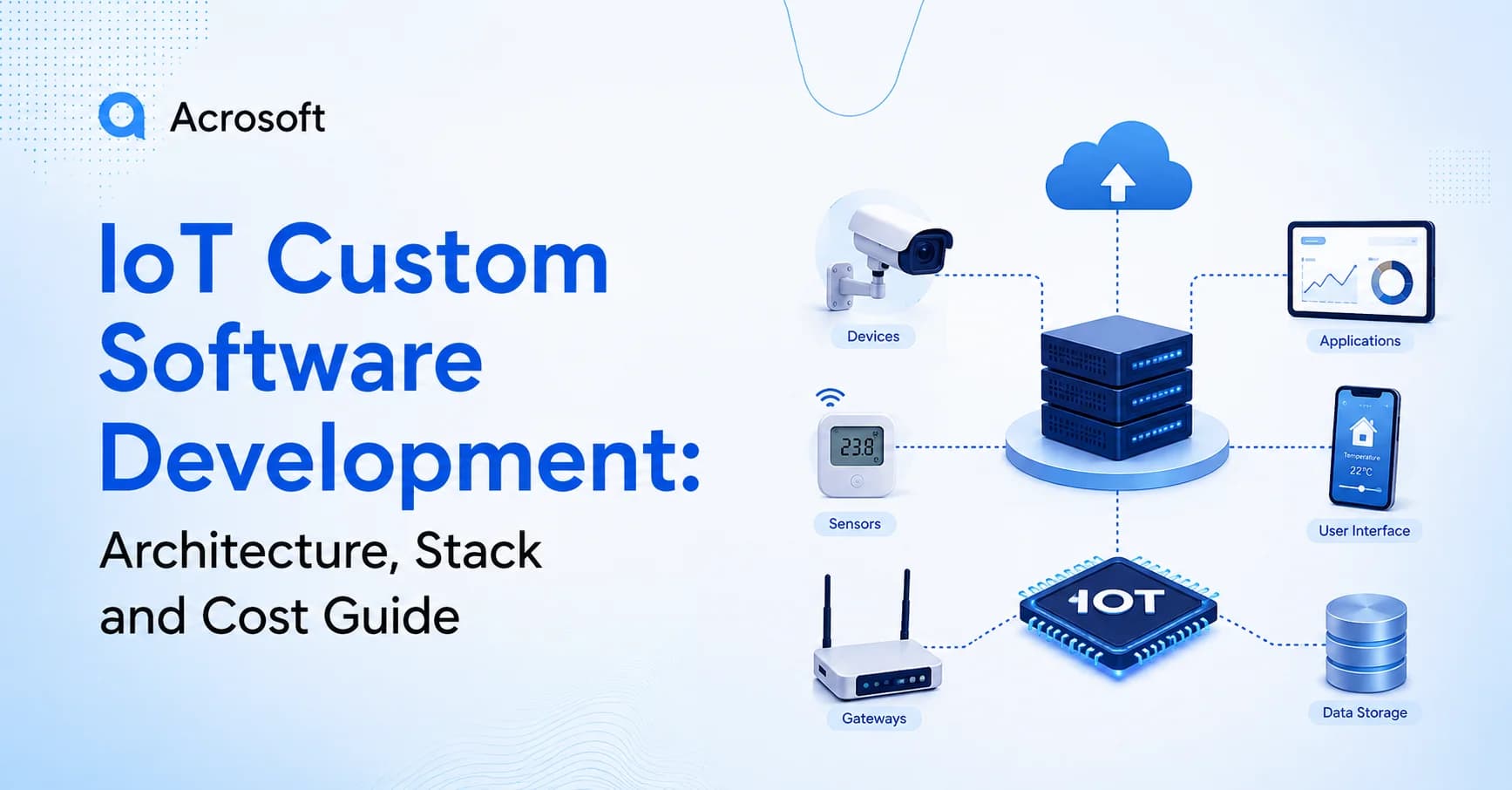
IoT software architecture defines how devices collect data, communicate with other components, and deliver useful information to users. A well-designed architecture also determines where data gets processed, how systems recover from failures, and how devices remain secure throughout their lifecycle.
A typical IoT architecture has five main layers.
1. Device and Sensor Layer
The device layer includes physical equipment, sensors, actuators, microcontrollers, and embedded software. Sensors collect information such as temperature, pressure, motion, location, and energy consumption. Actuators can perform physical actions, such as opening a valve or adjusting a machine setting.
Developers select hardware and firmware based on processing requirements, power limits, environmental conditions, and device capabilities. They must also consider how devices will receive software updates and recover from faults.
2. Connectivity and Network Layer
The connectivity layer transfers data between devices, gateways, and software platforms. The connection method depends on the required range, bandwidth, power consumption, and network availability.
Common options include Wi-Fi, Bluetooth Low Energy (BLE), Ethernet, cellular networks, and LoRaWAN. Some systems communicate directly with cloud services, while others use gateways to connect local devices.
A reliable design must account for weak signals, interrupted connections, and delayed messages. Local buffering and reconnection logic can help prevent temporary network failures from causing data loss.
3. Edge Computing and Data Processing Layer
The processing layer receives device data, validates messages, applies business rules, and prepares information for storage or analysis. Developers can run these tasks in the cloud, on local gateways, or across both environments.
Edge computing processes selected data near the device instead of sending every event to a remote server. This approach can reduce response times and network traffic when the application needs local decisions or must continue working during an internet outage.
Cloud processing remains useful for centralized monitoring, historical analysis, reporting, and coordination across multiple locations.
4. Application and Integration Layer
The application layer gives users access to device information and system controls. It can include web dashboards, mobile applications, administrative portals, reporting tools, and APIs.
For example, a facility manager may use a dashboard to monitor equipment across several buildings. A maintenance team may receive alerts when a machine exceeds a configured temperature limit.
APIs also connect IoT software with enterprise systems such as ERP, CRM, inventory management, and maintenance platforms. These integrations help businesses use device data within their existing workflows.
5. Security and Device Management Layer
Security and device management affect every part of the architecture. The system must identify devices, control access, protect data, and track software versions.
Important controls include encrypted communication, secure credential storage, role-based permissions, signed firmware updates, and device revocation. Monitoring and audit logs also help teams investigate unexpected behavior.
Security requirements should guide architecture decisions from the start. Adding them after deployment can require expensive changes to firmware, communication protocols, and application logic.
What Technology Stack Should You Choose for IoT Development?
The right IoT technology stack depends on your hardware, connectivity requirements, development team's skills, and expected device volume. You should select technologies based on specific technical needs instead of choosing tools simply because they are popular.
Component | Common Technologies | Best Fit |
Hardware and prototyping | Arduino, Raspberry Pi, ESP32 | Prototypes, embedded projects, and connected devices |
Firmware development | C, C++, Rust, FreeRTOS, Zephyr | Device control, sensor communication, and resource-constrained hardware |
Connectivity | Wi-Fi, BLE, Ethernet, cellular, LoRaWAN | Communication based on range, power, and bandwidth |
Messaging protocols | MQTT, HTTPS, CoAP, AMQP | Device telemetry, commands, and application communication |
Industrial communication | OPC UA | Industrial equipment and system interoperability |
Cloud platforms | AWS IoT Core, Microsoft Azure IoT services | Device connectivity, data ingestion, and centralized management |
Backend development | Python, Node.js, Java, .NET | APIs, business logic, data processing, and integrations |
Databases | PostgreSQL, time-series databases, object storage | Device records, telemetry, historical data, and reporting |
Web applications | React, Angular, TypeScript | Monitoring dashboards and administrative portals |
Mobile applications | Flutter, React Native, Swift, Kotlin | Remote monitoring and mobile device control |
Monitoring and analytics | Grafana, cloud monitoring tools, Power BI | Operational visibility, reporting, and performance tracking |
These technologies serve different purposes, so you do not need every option in one project.
If your IoT solution needs a Python-based backend, review Acrosoft's Python development services to understand its application development, API integration, and backend capabilities.
How to Choose the Right IoT Communication Protocol
Communication protocols determine how devices exchange data with gateways, applications, and cloud platforms. The right choice depends on network conditions, device capabilities, and application requirements.
MQTT uses a publish-and-subscribe model to exchange messages efficiently. It suits IoT applications that send frequent updates over limited or unreliable networks. For technical details, consult the official MQTT Version 5.0 standard.
HTTPS supports request-response communication between devices, APIs, and cloud services. It suits IoT applications that exchange data through standard web infrastructure, send information to cloud platforms, or request updates from connected systems.
CoAP provides lightweight request-response communication for constrained devices and networks. It suits IoT applications that exchange small amounts of data while operating with limited processing power, memory, or network bandwidth.
BLE connects nearby devices with smartphones, tablets, and gateways over short distances. It suits wearables, sensors, and consumer electronics that need low-power communication without relying on continuous Wi-Fi connectivity.
LoRaWAN supports long-range communication while keeping device power consumption low. It suits remote sensors that transmit small amounts of data periodically, especially in agricultural, environmental monitoring, and other wide-area applications.
OPC UA enables structured data exchange between industrial devices, control systems, and software applications. It suits manufacturing and automation environments where equipment from different vendors needs to communicate and share operational information reliably.
Choose the protocol according to your use case, device capabilities, network conditions, and security requirements. Using a protocol that does not fit the application can increase development effort and operating costs.
AWS IoT or Microsoft Azure IoT?
AWS and Microsoft Azure offer cloud services that can support IoT applications. The best choice depends on your existing infrastructure, device requirements, integration needs, and preferred cloud environment.
AWS IoT Core provides device connectivity, message routing, and integration with other AWS services. Microsoft Azure offers IoT-related capabilities through its cloud and industrial IoT services.
Compare the services available for your specific deployment before choosing a platform. Check device provisioning, identity management, regional availability, monitoring, data retention, integration options, and pricing.
Also review the platform's current product lifecycle and service availability. Cloud product names, capabilities, and support arrangements can change over time.
What Is the IoT Software Development Process?
Custom IoT development requires coordination between hardware, firmware, cloud infrastructure, applications, and security. A staged process helps your team validate important decisions before committing to a full implementation.
Stage 1: Discovery and Requirements Planning
Start by defining the business problem, target users, device requirements, and expected outcomes. Identify the data you need to collect and the actions the system should support.
Document the required integrations, security controls, network conditions, and operating constraints. The discovery stage should produce a defined scope, initial architecture, project risks, and acceptance criteria.
Stage 2: Technical Feasibility and Prototyping
Build a small proof of concept to test the most uncertain parts of the project. This may include connecting a sensor, transmitting data, testing network coverage, or verifying that an existing device supports the required commands.
Use representative hardware whenever possible. A successful demonstration with simulated data does not prove that the complete system will work reliably in real operating conditions.
Stage 3: Architecture and Technology Selection
Define the system's layers, communication protocols, cloud services, databases, APIs, and application components. Decide which tasks need edge processing and which can run in the cloud.
Plan device identity, access control, data retention, failure recovery, and software updates. These decisions establish the technical foundation for development and help the team estimate the work more accurately.
Stage 4: Software and Firmware Development
Develop the device firmware, backend services, APIs, dashboards, and mobile applications required by the agreed scope. Connect these components in small, testable increments rather than waiting until every part is complete.
Use code reviews, automated tests, and clear interface definitions to reduce integration problems. Regular demonstrations also help stakeholders review progress and identify gaps before they become expensive changes.
Stage 5: Integration and Quality Assurance
Connect the software components with the actual devices, cloud services, and business systems. Test each component independently and then verify how the complete solution behaves.
Testing should cover device communication, data accuracy, permissions, network interruptions, performance, and security. Field testing can reveal problems that do not appear in a controlled development environment.
Stage 6: Deployment and Launch
Prepare the production environment, configure monitoring, register devices, and verify the deployment process. Start with a controlled pilot when the system involves new hardware or uncertain operating conditions.
Confirm that users can access the required features and that support teams can identify common failures. Expand deployment after the solution meets its agreed acceptance criteria.
Stage 7: Maintenance and Continuous Improvement
Monitor the system after launch and address software defects, security issues, and changing operational requirements. Maintenance may include firmware updates, cloud infrastructure changes, database optimization, and application improvements.
Track device health, message delivery, system availability, and support incidents. These measures help your team identify problems and plan improvements as the connected device fleet grows.
How Much Does Custom IoT Software Development Cost?
The cost of custom IoT software development depends on the number of devices, system complexity, hardware requirements, integrations, security needs, and development effort. A simple monitoring application has different requirements from an industrial platform that manages multiple device types across several locations.
As an initial planning benchmark, the following ranges provide a broad starting point. They are illustrative estimates, not fixed market prices or a quote from Acrosoft.
Project Type | Estimated Development Cost | Typical Scope |
Basic IoT application | $10,000–$50,000 | Limited device support, basic monitoring, simple alerts, and a focused workflow |
Mid-complexity IoT solution | $50,000–$100,000 | Multiple devices, cloud connectivity, dashboards, APIs, and selected integrations |
Advanced IoT platform | $100,000–$200,000+ | Complex data processing, advanced access controls, multiple integrations, and broader device management |
Enterprise IoT ecosystem | $200,000+ | Large-scale deployments, multiple sites, complex infrastructure, extensive validation, and operational requirements |
Actual costs can fall outside these ranges. A small project may cost more if it requires custom hardware or specialized engineering. An enterprise project may also need a larger budget for field deployment, certification, and ongoing operations.
Before comparing quotes, check what each estimate includes. Hardware purchases, connectivity charges, cloud usage, certification, and long-term support may sit outside the software development budget.
What Factors Affect IoT Development Costs?
Several technical and business decisions influence the overall IoT development budget, including:
Project Scope and Feature Complexity: Basic dashboards require less development than platforms with remote device control, advanced analytics, and automated workflows. More features increase development and testing effort.
Hardware and Firmware Requirements: Existing compatible hardware can reduce costs, while custom circuit boards, specialized sensors, and embedded firmware require additional engineering.
Connectivity and Data Volume: Device count, communication methods, message frequency, and data volume affect network infrastructure, processing, and recurring connectivity costs.
Cloud Infrastructure and Data Storage: Device connections, data processing, analytics, monitoring, and storage requirements determine ongoing cloud expenses.
Integration With Existing Systems: Connecting IoT software with ERP, CRM, inventory platforms, and third-party APIs adds work based on API availability and system compatibility.
Security and Compliance Requirements: Device authentication, encryption, access controls, secure updates, and compliance validation add to development and testing costs.
Development Team and Project Duration: Team size, technical expertise, location, and project complexity influence development rates and delivery timelines.
How Long Does IoT Software Development Take?
The timeline depends on the project scope, hardware readiness, integration requirements, and testing needs. The following ranges are illustrative planning estimates.
Project Stage or Type | Estimated Duration | Main Deliverables |
Discovery and feasibility | 2–6 weeks | Requirements, risk assessment, architecture direction, and technical proof |
Basic IoT MVP | 2–4 months | Core device connection, essential features, and a working user interface |
Mid-complexity solution | 4–6 months | Multiple device workflows, integrations, testing, and a controlled rollout |
Enterprise IoT platform | 6–12 months or longer | Complex integrations, device fleet management, security validation, and staged deployment |
These stages can overlap when dependencies allow. However, custom hardware development, external approvals, and limited access to test environments can extend the schedule.
A useful project plan separates software engineering time from hardware lead times and other external dependencies. It should also define milestones and acceptance criteria so stakeholders can track progress.
How to Secure and Scale an IoT Solution
Security and scalability require attention from the beginning of an IoT project. A system that works with a few test devices may face different challenges when it manages a much larger fleet.
Protect Devices and Data
Give each device a unique identity instead of relying on shared credentials. Use encrypted communication, appropriate access permissions, and secure storage for sensitive credentials.
The importance of device security is clear from a September 2026 report by the U.S. Government Accountability Office. Only 7 of 22 civilian CFO Act agencies had fully met all three federal requirements for managing networked devices. The report, Internet of Things: OMB Action Needed to Ensure Agencies Secure Their Networked Devices, highlights the need for proper device inventories and security controls.
Keep firmware and software updates controlled and verifiable. The system should also support credential rotation, device revocation, and timely security fixes.
For practical security recommendations, consult NIST's Foundational Cybersecurity Activities for IoT Product Manufacturers. This guidance covers security activities that manufacturers should consider before and after releasing connected products.
Plan for Growing Device Fleets
Design device registration, message handling, and data storage to support expected growth. Estimate future device counts and message volumes before selecting infrastructure.
Use monitoring tools to track connectivity, processing delays, errors, and resource usage. These metrics help teams detect bottlenecks before they affect more users.
Build for Network Failures
Devices may lose connectivity because of weak signals, power interruptions, or network maintenance. The software should define what happens during these failures.
Depending on the use case, devices may store data locally, retry failed messages, or continue selected operations at the edge. Test recovery behavior before deploying the system at scale.
Monitor Performance and Operating Costs
Review cloud usage, data retention, message volume, and infrastructure consumption after launch. Remove unnecessary processing and avoid retaining data longer than the business requires.
Performance monitoring should cover the entire system, from device communication to the user interface. This gives the team a clearer view of where delays or failures occur.
How to Choose an IoT Software Development Company
The right development partner should understand how hardware, software, connectivity, and business processes work together. Evaluate the team's technical approach and project planning before making a commitment.
Use these questions when comparing providers:
Architecture: Can the team explain its proposed architecture and the reason for each major technology choice?
Hardware Experience: Can it work with your existing devices, sensors, firmware, or selected hardware platform?
Integration: Can it connect the solution with your current business systems and data sources?
Security: How will it manage device identities, permissions, data protection, and firmware updates?
Testing: Does its plan include hardware testing, network failure scenarios, and field validation?
Cost Transparency: Does the estimate identify assumptions, exclusions, recurring charges, and possible cost changes?
Maintenance: Who will manage updates, monitoring, troubleshooting, and future improvements?
Ownership: Will your agreement clearly define access to source code, documentation, infrastructure, and project deliverables?
Ask providers to explain how they would approach your specific use case. A clear technical proposal should connect architecture choices to project requirements, risks, budget, and operational needs.
Acrosoft can be considered as a potential development partner when you need a custom IoT solution aligned with your business requirements. Review our IoT app development services, confirm the proposed scope, and request an estimate based on your actual requirements.
To Conclude!
Custom software development for IoT requires careful planning across architecture, hardware, connectivity, applications, security, and maintenance. The right technology stack should match your device capabilities, data requirements, and business goals.
Start by defining one clear use case, validating the most important technical assumptions, and estimating both development and operating costs. A focused first release gives your team a practical way to test the solution before expanding its features or device fleet.
With a clear scope and a well-planned architecture, you can make better development decisions and prepare your IoT solution for reliable operation.
FAQs
A prototype tests whether the technology works. An IoT MVP includes essential features that real users can test in a controlled environment.